Adjust display and reading options to suit your needs.
Text and reading
Text size
Colour and contrast
Color Theme
Navigation and support
Institutional Chronicle
Royal Malaysia Police Historical Timeline
Explore the complete account of Malaysian policing from the Melaka Sultanate’s security system and the formation of a modern force in 1807 through the state forces, the Emergency, Royal recognition and the modernisation of the Royal Malaysia Police.
Coverage
1400 – 1969
Historical records
35 events
Select play to listen
35 events
No matching historical record was found. Try another keyword or clear the search.
1400–1795
Early Policing Heritage
The foundations of security and law administration evolved from the Melaka Sultanate through Portuguese and Dutch rule.
Historical event
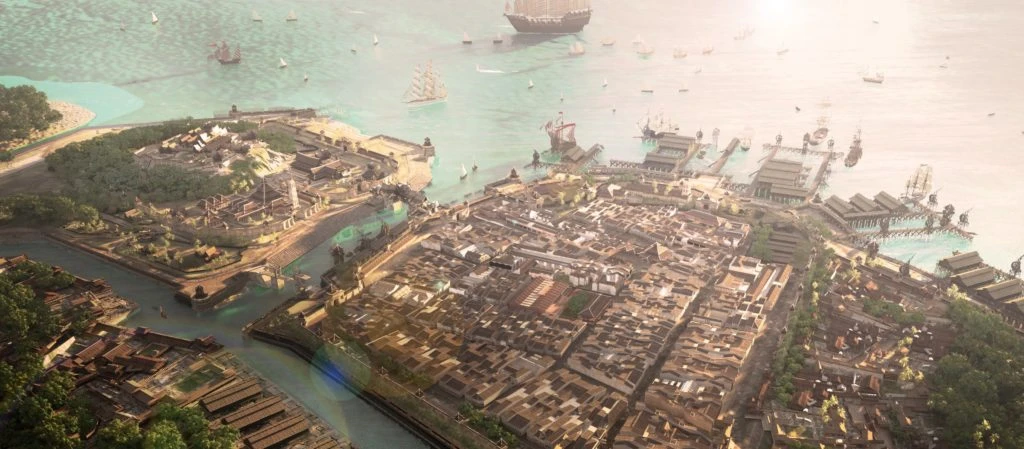
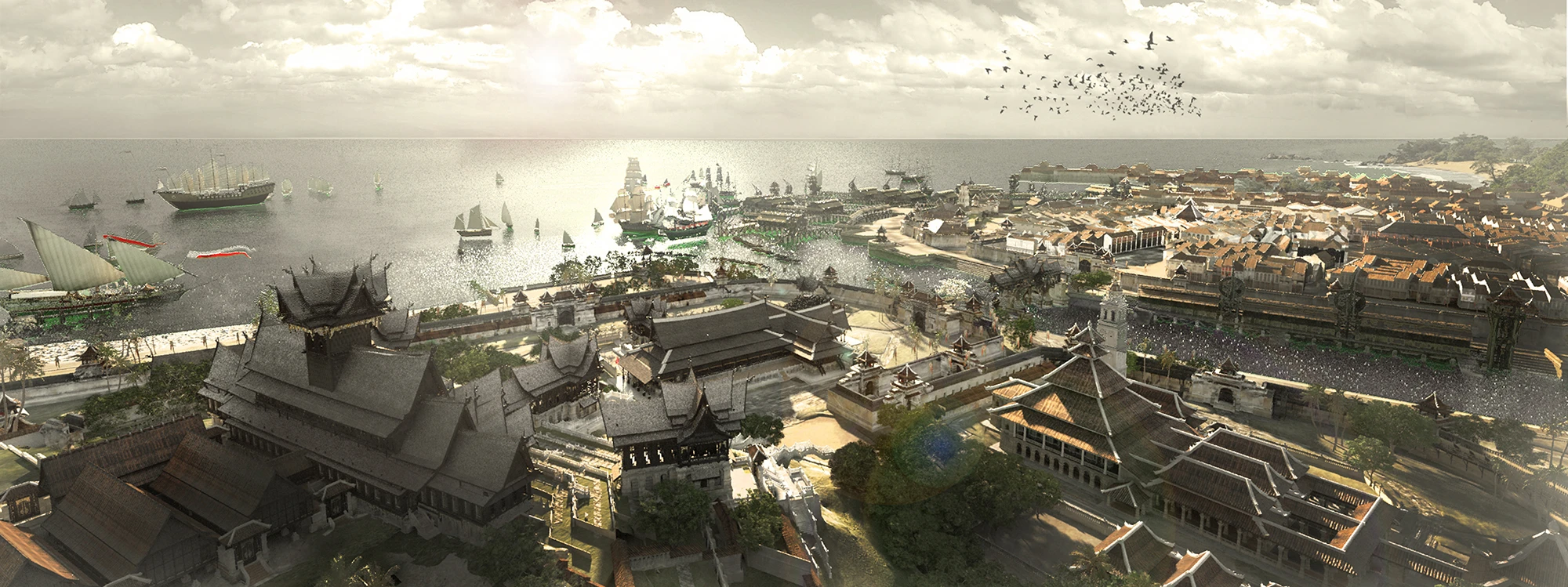
Policing under the Melaka Sultanate
Key FactsPeriod: Around the 15th centuryThe system that exists in Malacca may be followed by other Malay states.In every civilization of a nation there is an enforcement body that implements the laws and regulations of society and the country.Historical NarrativeIn every civilization of a nation there is an enforcement body that implements the laws and regu…
Read full historical narrative
Key Facts
Period: Around the 15th century
The system that exists in Malacca may be followed by other Malay states.
In every civilization of a nation there is an enforcement body that implements the laws and regulations of society and the country.
Historical Narrative
In every civilization of a nation there is an enforcement body that implements the laws and regulations of society and the country. The history of policing in Malaysia begins with the glorious history of the Malay sultanate. It cannot be denied that there has been an institution of officers with police functions since the Hindu Kingdom of Majapahit and the Sri Vijaya Buddhist Empire. Although there are records about rules and laws but not much detail is obtained. Melaka is the oldest Malay kingdom. During the absence of the Sultan of Melaka, the Treasurer has the absolute power to impose punishment. Temenggung also acts as an officer. It is his job to catch criminals, build prisons and carry out punishments. In addition to Temenggung, the Penghulu also have their own "police force". The main task of this team is to collect taxes and enforce the law and keep the village safe.
The system that exists in Malacca may be followed by other Malay states. A legal "digest" compiled for Abd Al Ghafur Muhaiyud Din Shah - Sultan of Pahang (1592-1614) - narrates that Temenggung appointed by the king was responsible for guarding the port, solving crime problems, markets, roads, towns, weights and measures. Temenggung who has a bodyguard, is required to oversee prison inspections, act justly, find trusted followers and consult with peers. That is the general picture we can see through the available records, regarding the Malay classic legal administration system.
Historical event
Melaka under Portuguese and Dutch rule
Key FactsPeriod: 1509–1795On August 10, 1511, the Portuguese fleet led by Alfonso de Albuquerque successfully conquered Malacca.Melaka was once again colonized when the Dutch succeeded in seizing it from the Portuguese on 14 January 1641.In 1795 Malacca changed hands again when the British were entrusted to temporarily own the colony on behalf of the Dutch …
Read full historical narrative
Key Facts
Period: 1509–1795
On August 10, 1511, the Portuguese fleet led by Alfonso de Albuquerque successfully conquered Malacca.
Melaka was once again colonized when the Dutch succeeded in seizing it from the Portuguese on 14 January 1641.
In 1795 Malacca changed hands again when the British were entrusted to temporarily own the colony on behalf of the Dutch King who had to flee after the French successfully occupied the Netherlands.
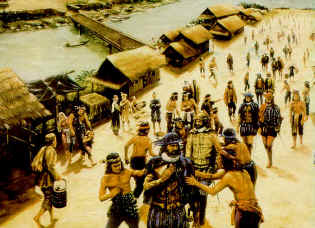
The painting depicts the arrival of the Portuguese to the State of Malacca in 1509.
View of Melaka City by a Portuguese painter in 1511
Historical Narrative
On August 10, 1511, the Portuguese fleet led by Alfonso de Albuquerque successfully conquered Malacca. According to Tome Pires, the Portuguese writer who produced 'Suma Oriental' the old administrative system is still used to control the Asian residents there. Portuguese colonists governed Malacca militarily. All work and policing duties were carried out by Portuguese soldiers. By 1511 Melaka had become a cosmopolitan society. The Portuguese prefer to govern Malacca by using the "Captain" system. Under this system the tribes will be placed under a chieftain. This chief acts as a police institution to maintain his power. The word "Kapitan" comes from the Sepanyaol language and it is possible that the system was used in other Portuguese colonies.
Melaka was once again colonized when the Dutch succeeded in seizing it from the Portuguese on 14 January 1641. The Dutch also ruled Melaka by using a military system in addition to continuing the 'captain' system introduced by the Portuguese. When the population of Europe increased and there was a need for policemen, a police force called 'Burgher Guard' was established. The Burgher Guard was a new body and its officers consisted of Dutchmen living in Malacca. His subordinates are local natives. The police force is responsible to the Council of Justice whose members are elected from among the Dutch in Malacca. Penghulu also carried out police duties during Malacca under Dutch rule.
In 1795 Malacca changed hands again when the British were entrusted to temporarily own the colony on behalf of the Dutch King who had to flee after the French successfully occupied the Netherlands.
The painting depicts the arrival of the Portuguese to the State of Malacca in 1509. The Portuguese were the first Europeans to set foot in Malacca.
View of Melaka City by a Portuguese painter in 1511
Historical Gallery
Melaka under Portuguese and Dutch rule — historical image 2Melaka under Portuguese and Dutch rule — historical image 3
1786–1871
Foundations of Modern Policing
Modern police institutions emerged in Penang, Melaka and Singapore before consolidation within the Straits Settlements.
Historical event
Penang Police
Key FactsPeriod: 1786–1948On August 11, 1786, Francis Light landed in Penang and named it Prince of Wales Island.In 1787, several riots occurred in Penang.However, with his wisdom, in 1792, Francis Light appointed a tribal leader called "Captain" for each Malay, Chinese and Chulia (South Indian race).This way of maintaining safety by having a Captain was no…
Read full historical narrative
Key Facts
Period: 1786–1948
On August 11, 1786, Francis Light landed in Penang and named it Prince of Wales Island.
In 1787, several riots occurred in Penang.
However, with his wisdom, in 1792, Francis Light appointed a tribal leader called "Captain" for each Malay, Chinese and Chulia (South Indian race).
This way of maintaining safety by having a Captain was not entirely successful because Francis Light could not appoint a Captain for the Europeans.
Until this period, Francis Light had several times sent applications to the Board of Directors of the East India Company to establish an official police force but did not receive a response.
Historical Narrative
On August 11, 1786, Francis Light landed in Penang and named it Prince of Wales Island. He acted on behalf of the East India Company headquartered in India. The inhabitants of Penang at that time were Malay fishermen who were small in number. Three years later, the population of Penang increased to 10,000 people plus immigrants from abroad. At that time Francis Light found it necessary for him to establish a police body to maintain security in Penang. He appealed to his superiors in India on this matter but received no treatment. In the meantime he was given the rank of Superintendent and instructed to do his work alone. With that, he had to use the breeze that came with him from India. But this breeze was found to be undisciplined.
In 1787, several riots occurred in Penang. Several European sailors were involved and 2 Siamese were killed. Once again Francis Light wrote to the Governor-General of the East India Company (Lord Cornwallis) in India to legislate and establish a police force on the island but this was also rejected.
However, with his wisdom, in 1792, Francis Light appointed a tribal leader called "Captain" for each Malay, Chinese and Chulia (South Indian race). They act as magistrates in minor cases. For other cases the accused will be brought before the Superintendent. Each Captain is also responsible for controlling several districts with the help of 5 "peons". These peons can be considered as the first constables in the membership of low-ranking police officers that exist until now.
The duties and responsibilities of the police at that time included various aspects of administration such as the control of water supply and the registration of "stillbirths". After that, it also includes fire prevention and prison duties. However, their main work remains as law enforcers as they are currently.
This way of maintaining safety by having a Captain was not entirely successful because Francis Light could not appoint a Captain for the Europeans. These people are becoming more arrogant because they realize that they are free from the law. In 1793 when Europeans were involved in a murder case, Francis Light could not act because he was not authorized to act against Europeans.
Until this period, Francis Light had several times sent applications to the Board of Directors of the East India Company to establish an official police force but did not receive a response. On 21 October 1794 he died and was succeeded by Major Forbes Ross Macdonald in 1796.
Then, Col. Arthur Wellesley stopped in Penang on his way to Manila. He has made notes that touch on matters related to security in Penang and urges that a European magistrate be appointed.
On 19 April 1800 Sir George Leith arrived in Penang to take up his new position as Lieutenant-General. Four months later John Dicken was appointed as the first Judge and Magistrate in Penang.
In early 1804, R.T. Farquhar arrived in Penang replacing Sir George Leith as Lieutenant-General. The situation of the police force at that time was still weak. Various types of offenses are committed every day freely without action being taken and without being punished. In 1805, the entire administration of Penang was reorganized, and the status of the island was improved. A Governor was appointed and a House of Council responsible for the government of India was established.
On March 25, 1807, a "Charter" was received. With this, Penang can hold a real Court of Justice as well as establish a better police organization based on the 'Charter of Justice'. This charter has created a clear law for those who are responsible for implementing it.
Hutton Lane Police Station in 1880 Penang Courthouse in 1880 Brick Kiln Street Police Station 1800 Some of the special police involved in a roadblock in Cannon Square, 3 August 1867
Penang Police Fire Brigade in 1883 Parade of honor in conjunction with the official opening of 'Spring Court' on 12 January 1948 by Penang Marine Police Old Light Police Station Penang 23 June 1883 Photo taken in 1929 at Jalan Pitt Police Station Penang Simpang Enam Police Station Penang, 1900
Key FactsPeriod: 1795–1930When the Dutch King returned to the Dutch throne in 1819, Malacca was handed back to the Dutch.From the year 1825, British public administration began in Malacca.Melaka Police Training Center (in Bandar Hilir).Policemen's sex house in 1906.Melaka state police cadet parade in 1930Historical NarrativeAt first the British were asked t…
Read full historical narrative
Key Facts
Period: 1795–1930
When the Dutch King returned to the Dutch throne in 1819, Malacca was handed back to the Dutch.
From the year 1825, British public administration began in Malacca.
Melaka Police Training Center (in Bandar Hilir).
Policemen's sex house in 1906.
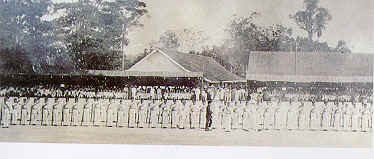
Melaka state police cadet parade in 1930
Historical Narrative
At first the British were asked to administer Melaka temporarily, when the Dutch king had to flee to England because his country was conquered by France. With that, the British took the right to Malacca in the name of their friend. This caused a slight change in the administrative pattern of Malacca. Captain Farquhar was appointed British Military Governor but the other Dutch officers continued to retain their posts. The Council of Justice and the Burgher Guard continue to be responsible for enforcing the law and maintaining public order.
When the Dutch King returned to the Dutch throne in 1819, Malacca was handed back to the Dutch. However, with the Anglo-Dutch Treaty of 1824 signed in London, the British gave up all their interests in Java and Sumatra and got all the Dutch interests (including Malacca) in Malaya.
From the year 1825, British public administration began in Malacca. A police force was later formed. Initially the Dutch `Burgher Guard' police system was maintained by the British. An English officer, W.T. Lewis was appointed Superintendent of Police. The strength of the Malacca Police Force under Lewis is 63 people. This includes two European constables namely W . Van Heusen and J. Endroff, four chiefs of the Burgher Guard, 28 peons and 21 penghulu. The total salary paid to all members is 1,025 rupees per month. Van Heusen, the senior constable was paid 60 rupees a month while peons and penghulu were paid up to ten rupees a month in addition to ten percent of the land revenue collection.
Lewis' duties as Chief of Police were comprehensive. He is also responsible for the fire brigade, control over the market and also the waters. In addition he also acted as a Land Administrator and Revenue Collector. As piracy was a major crime problem at the time, Lewis suggested the establishment of permanent bases of paramilitary police stations. The resident at the time, Samuel Garling, only agreed to establish a police post on Pulau Besar and ordered Lewis to recruit Peons to guard the stations in Merlimau and Sungai Linggi.
Lewis is the founder of the Malacca Police Force. With his earnest efforts, he made the Melaka Police an efficient force among other Straits State Police Forces.
Melaka Police Training Center (in Bandar Hilir). Seen the trainees undergoing training in 1929.
Policemen's sex house in 1906.
Melaka state police cadet parade in 1930
Jasin Police Station (old) was built before the Second World War
Tengkera Police Station, Malacca
Batang Tiga Police Station, Malacca
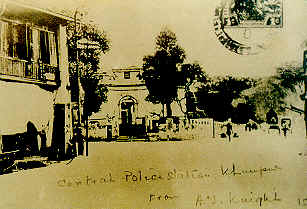
Melaka Central Police Station
Historical Gallery
Melaka under British rule — historical image 2Melaka under British rule — historical image 3Melaka under British rule — historical image 4Melaka under British rule — historical image 5Melaka under British rule — historical image 6Melaka under British rule — historical image 7Melaka under British rule — historical image 8
Historical event
History of the Singapore Police
Key FactsPeriod: 1819–1843Based on the experience that existed in the previous British settlements, Raffles acted immediately to establish a police force in Singapore shortly after the island was handed over to the British.Thomas Dunman - Singapore Deputy and Superintendent of Police 1843A Police Station in Singapore in 1825.Historical NarrativeBased on the…
Read full historical narrative
Key Facts
Period: 1819–1843
Based on the experience that existed in the previous British settlements, Raffles acted immediately to establish a police force in Singapore shortly after the island was handed over to the British.
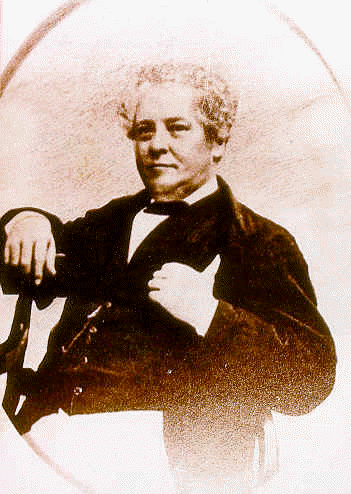
Thomas Dunman - Singapore Deputy and Superintendent of Police 1843
A Police Station in Singapore in 1825.
Historical Narrative
Based on the experience that existed in the previous British settlements, Raffles acted immediately to establish a police force in Singapore shortly after the island was handed over to the British. P. J. Bernard led the Police Force with the help of a Malay writer, a goaler, a jemadar or Sergeant and eight constables with jemadar, as well as nine pedars whose salaries were paid through a fund established by local merchants. With the rapid development of Singapore, the Police Force was also enlarged. In 1841 the police force consisted of a ``Sitting Magistrate'' as Superintendent of Police with three European Constables, an assistant Constable, fourteen officers and 110 spies. In 1843, the Singapore Police Force entered a new era with the appointment of Thomas Dunman as Deputy Magistrate and Superintendent of Police.
Dunman is diligent in his work. He contributed a lot to the development of the Singapore Police Force for almost thirty years. While under his leadership, the Singapore Police Force emerged as a disciplined, efficient and capable Police Force capable of facing various problems.
Thomas Dunman - Singapore Deputy and Superintendent of Police 1843
A Police Station in Singapore in 1825. Policemen of the Straits Settlements (Singapore) in 1825 "Municipal" Offices in Singapore during the visit of the Malay Kings
Historical Gallery
History of the Singapore Police — historical image 2History of the Singapore Police — historical image 3History of the Singapore Police — historical image 4
Historical event
Straits Settlements Police Force
Key FactsPeriod: 1826–1946 Sub-Inspector Mohd Dat from the Straits Settlements Police Force (Penang in the 1930s)Mr.Mr.Mr.Members of the Straits Settlements Police 1939, Led by Mr.Historical Narrative Sub-Inspector Mohd Dat from the Straits Settlements Police Force (Penang in the 1930s)Mr. W. A. Cuscaden, ISO, Chief of Police of the Straits Settlements 19…
Read full historical narrative
Key Facts
Period: 1826–1946
Sub-Inspector Mohd Dat from the Straits Settlements Police Force (Penang in the 1930s)
Mr.
Mr.
Mr.
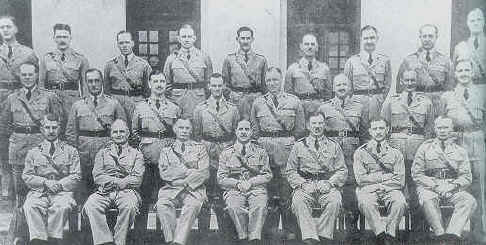
Members of the Straits Settlements Police 1939, Led by Mr.
Historical Narrative
Sub-Inspector Mohd Dat from the Straits Settlements Police Force (Penang in the 1930s)
Mr. W. A. Cuscaden, ISO, Chief of Police of the Straits Settlements 1906-1914 Mr. A.R. Chancellor, CBE, Chief of Police of the Straits Settlements, 1914-1923 Mr. H. Fairburn, CMG, Chief of Police of the Straits Settlements 1925-1935
Mr. R. H. De Onreat, CMG. Chief of Police of the Straits Settlements 1935-1939
Mr. A.H. Dickinson, OBE. Chief of Police of the Straits Settlements 1939-1946
Members of the Straits Settlements Police 1939, Led by Mr. J.N.M. A. Nicholls, D.C.P.
Historical Gallery
Straits Settlements Police Force — historical image 2Straits Settlements Police Force — historical image 3Straits Settlements Police Force — historical image 4Straits Settlements Police Force — historical image 5Straits Settlements Police Force — historical image 6
1841–1914
Formation of State Police Forces
State police forces were formed and strengthened as administration changed across the Peninsula, Sarawak and North Borneo.
Historical event
Perak Police Force
Key FactsPeriod: 1873–1954Governor Sir Andrew Clarke has decided to intervene in Perak.T.C.S.Members of the 'Malay State Guides' Wearing 'Inspection Lines' in 1910.Janing Hulu Perak Police Station (1890)In December 1876, the first Commissioner of the Perak Police Force was appointed.Historical NarrativeGovernor Sir Andrew Clarke has decided to intervene in …
Read full historical narrative
Key Facts
Period: 1873–1954
Governor Sir Andrew Clarke has decided to intervene in Perak.
T.C.S.
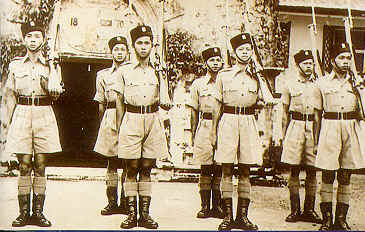
Members of the 'Malay State Guides' Wearing 'Inspection Lines' in 1910.
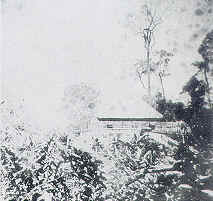
Janing Hulu Perak Police Station (1890)
In December 1876, the first Commissioner of the Perak Police Force was appointed.
Historical Narrative
Governor Sir Andrew Clarke has decided to intervene in Perak. He then concluded the Pangkor Agreement to resolve the confusion in Perak. The Pangkor Treaty was signed in January 1874. Speedy was then appointed Assistant Resident. The first Perak resident was J . W. W. Birch. The Police Force formed by Speedy was enlarged to 160 members. In addition to the members recruited from India, some Malay and Chinese members were also recruited. An Indian Inspector is assigned to help Speedy. Police forces are stationed in an area between Matang and Taiping. At that time there was no specific uniform and the conditions of the barracks were not perfect.
T.C.S. Speedy Perak Police Chief 1873-1874
Members of the 'Malay State Guides' Wearing 'Inspection Lines' in 1910.
Janing Hulu Perak Police Station (1890)
In December 1876, the first Commissioner of the Perak Police Force was appointed. He is Paul Swinburns. The policemen recruited by Speedy were absorbed into the newly formed Police Force by Swinburne. Some Malay policemen from the Straits Settlements were also transferred to Perak. Swinburne also plans to build police barracks and new police stations in Tanjung Piandang, Kuala Larut and Durian Sebatang. New uniforms were also obtained from England. The Police Force is known by the nickname - Perak Armed Police (Perak Armed Police). The Police Force is functional, functional, disciplined and administered in a military manner.
On October 3, 1879 a riot broke out in Taiping. The Police managed to control the situation. The efficiency of the police was thanks to the system of training and administration devised by Swinburne. Swinburne was replaced by Captain Walker in 1882. Walker then formed a Mounted Battery led by Inspector James McKeon. Walker also put together a systematic investigation system when he led the Perak Police Force. The Perak Police Force grew until it was later united with other Police Forces in the Federated Malay States Police Force.
Members of the Perak Police accompanied J.W.W. Birch British Resident in Perak while visiting Selangor State in 1874
The Perak mounted police force for His Majesty the Sultan of Perak in 1915
Teluk Anson Police Station, Perak in 1893. Tapah Police Station, Perak, 1936
The 'Malay State Guides' banner bestowed by the Sultan of Perak, Selangor, Pahang, and the Yang Dipertuan Besar of Negeri Sembilan
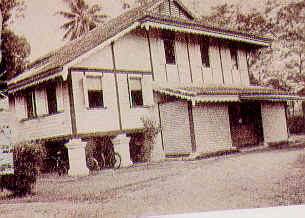
Pasir Itam Police Station, Perak 1935
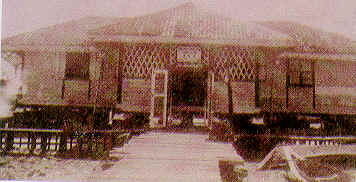
Kampong Simee Police Station, Perak was built in 1948.
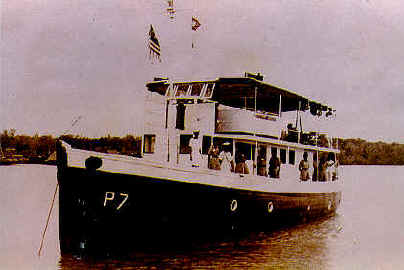
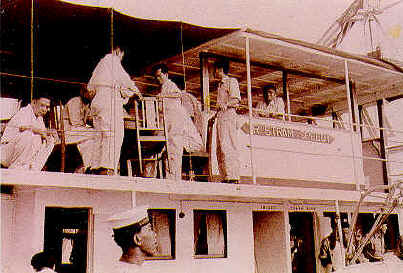
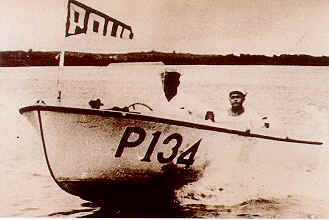
P7 Marine Boat 'Tristram Speedy' used as a floating Police Station in deep waters in 1954. People are dealing on board the police marine 'Tristram Speedy' floating police station.
Members of the Taiping Contingent Police walking past in front of the Larut District Office in 1953
Historical Gallery
Perak Police Force — historical image 2Perak Police Force — historical image 3Perak Police Force — historical image 4Perak Police Force — historical image 5Perak Police Force — historical image 6Perak Police Force — historical image 7Perak Police Force — historical image 8Perak Police Force — historical image 9Perak Police Force — historical image 10Perak Police Force — historical image 11Perak Police Force — historical image 12Perak Police Force — historical image 13
Historical event
Selangor Police Force
Key FactsPeriod: 1850–1980Sultan Abdul Samad ascended the throne of Selangor in 1857, His Majesty ruled Selangor and Kuala Lumpur.In 1870 the Sultan handed over the administration of the state to his son-in-law, Tengku Kudin from Kedah with the title Wakil Yamtuan.When Davidson was appointed British Resident in 1874, one of his main actions was to establish…
Read full historical narrative
Key Facts
Period: 1850–1980
Sultan Abdul Samad ascended the throne of Selangor in 1857, His Majesty ruled Selangor and Kuala Lumpur.
In 1870 the Sultan handed over the administration of the state to his son-in-law, Tengku Kudin from Kedah with the title Wakil Yamtuan.
When Davidson was appointed British Resident in 1874, one of his main actions was to establish a Police Force.
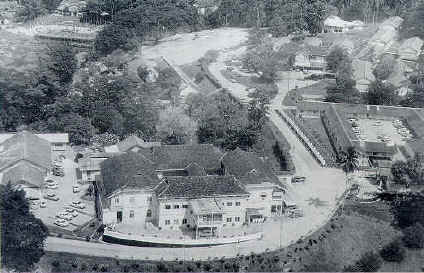
Bukit Aman (Bluff Road) in 1904
Two-storey house belonging to Syers (left) police barracks (right) above Bukit Ayang now known as Bukit Aman, above Kelab Selangor Kuala Lumpur, 1882.
Historical Narrative
Sultan Abdul Samad ascended the throne of Selangor in 1857, His Majesty ruled Selangor and Kuala Lumpur. The colony of Kiang was placed under the administration of King Abdullah. The Chinese came to the Kuala Lumpur area to mine tin in 1850. In 1867 King Abdullah was challenged by King Mahadi. Thus began the Kiang War.
In 1870 the Sultan handed over the administration of the state to his son-in-law, Tengku Kudin from Kedah with the title Wakil Yamtuan. Some of Tengku Kudin's actions add to the mess of state administration. Tengku Kudin then established a Police Force. In 1871 he recruited two European officers - a Dutchman named Van Hagen and an Italian named Cavaleiri. The Police Force consisted of 30 Europeans and Serani and 80 Indian sepoys. Tengku Kudin was a close friend of Yap Ah Loy, Kapitan Cina at that time. In 1872, Tengku Kudin stationed most of his Police Force members in Kuala Lumpur to face the threat of Syed Masyhur who was also Yap Ah Loy's staunch enemy. Kuala Lumpur was captured by Syed Masyhur in August of the same year. Tengku Kudin's forces were ambushed by another group of dissidents led by Raja Mahadi. Cavaleiri and 20 members of Tengku Kudin's team were killed. Ah Loy had to flee from Kuala Lumpur. Meanwhile Van Hagen and 40 of his members were captured and executed in Kuala Lumpur.
When Davidson was appointed British Resident in 1874, one of his main actions was to establish a Police Force. The formation of the Police Force was entrusted to a young officer named Harry Syers. In July 1875, he was appointed as Superintendent of Police and Jail of Selangor. By October 1878 the members of the Selangor Police Force increased to 270 and all of them were Malays. Police stations were also established in Kiang, Kuala Lumpur, Damansara, Kubu Lama, Sungai Pelong, Hulu Selangor, Sabak Bernam, Jugra, Kancing, Krian and Hulu Langat. The police force is known as Pasuka Polis Tentera Selangor (Selangor Military Police Force).
Bukit Aman (Bluff Road) in 1904
Two-storey house belonging to Syers (left) police barracks (right) above Bukit Ayang now known as Bukit Aman, above Kelab Selangor Kuala Lumpur, 1882.
Capt. Syers was the first Chief of Police with the Selangor Police Force in 1896.
Bukit Aman (Bluff Road) in 1904.
Bugle blowers in Bukit Aman in 1896.
Federated Malay States Police (F.M.S.) 1936.
Control of honor at the Selangor Club field by the Federated Malay States Police (F.M.S.)
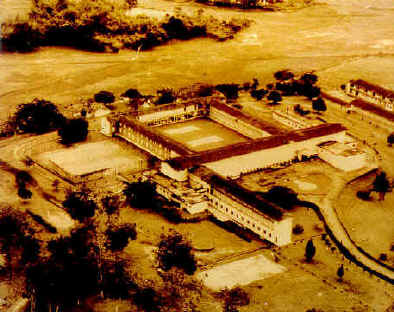
Bukit Aman Police Headquarters in the 1970s.
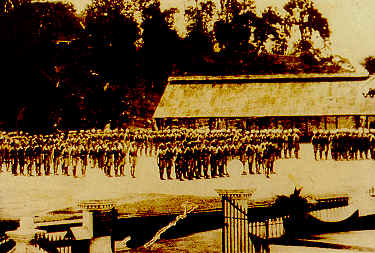
Federated Malay State Police (F.M.S.) recruits are lining up at the Wire Field of the Police Training Center, Bukit Aman - 1920.
Capt. Cheers. Head of Selangor in 1896.
The 'Trolley Patrol' Patrol Team in the State of Selangor in 1933
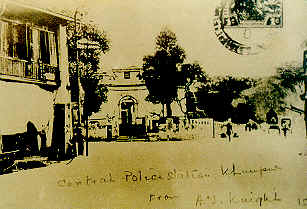
Kuala Lumpur Central Police Station (Jalan Bandar) in 1850
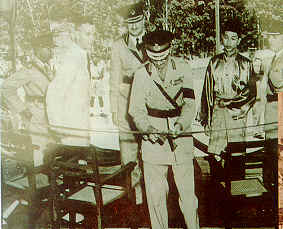
Kuala Kubu Bahru Police College, Selangor which was inaugurated by Sir Gerald Templer in 1953.
The Raja Abdullah Building became the Klang District Police Headquarters in the years 1880-1980
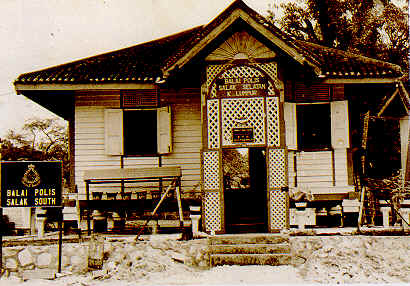
South Salak Police Station, Kuala Lumpur.
Petaling Police Station, Kuala Lumpur.
Historical Gallery
Selangor Police Force — historical image 2Selangor Police Force — historical image 3Selangor Police Force — historical image 4Selangor Police Force — historical image 5Selangor Police Force — historical image 6Selangor Police Force — historical image 7Selangor Police Force — historical image 8Selangor Police Force — historical image 9Selangor Police Force — historical image 10Selangor Police Force — historical image 11Selangor Police Force — historical image 12Selangor Police Force — historical image 13Selangor Police Force — historical image 14Selangor Police Force — historical image 15Selangor Police Force — historical image 16
Historical event
Pahang Police Force
Key FactsPeriod: 1880s–1937Pahang received British Residents after Perak, Selangor and Sungai Ujong.By 1890, the Pahang Police Force had grown in size with members consisting of 104 Sikhs, 142 Malays, a European Inspector named Summer and a Malay Inspector named Tuan Kechut.At the end of 1891, an anti-British uprising broke out in Pahang.Pekan Police Statio…
Read full historical narrative
Key Facts
Period: 1880s–1937
Pahang received British Residents after Perak, Selangor and Sungai Ujong.
By 1890, the Pahang Police Force had grown in size with members consisting of 104 Sikhs, 142 Malays, a European Inspector named Summer and a Malay Inspector named Tuan Kechut.
At the end of 1891, an anti-British uprising broke out in Pahang.
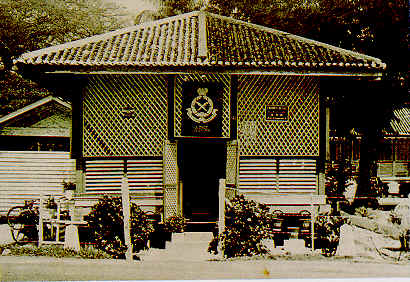
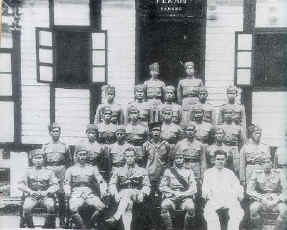
Pekan Police Station, Pahang 1937 with W.L.R.
Historical Narrative
Pahang received British Residents after Perak, Selangor and Sungai Ujong. The Sultan made a residence in Pekan which is located at the mouth of the Pahang River. In the early 1880s, the British began to insist that the Sultan accept the services of a British Resident to allow the British to intervene in the state. So in 1888 Pahang accepted the insistence of the British, clan J.P. Rodger was appointed the first British Resident. An important first step taken by Rodger who used to work with H.C. Syers in Selangor is asking the Police Superintendent of the Selangor Prison clan to help him form the Pahang Police Force. Syers was asked to recruit and train a group of 25 Sikhs as basic members and prepare a Sergeant, Corporal and Bugle for the Police Force to be established. For the time being, some volunteer members of the Selangor Police were selected to serve with the Pahang Police Force. The team sent to Pahang consisted of a Sergeant, a Corporal, 23 Sipahis, and a Bugle led by Inspector Cross. This team left Singapore for Pekan on 18 October 1888 accompanied by the Pahang Resident himself. Upon arrival in Pahang, Inspector Cross fell ill and died in November of the same year. Inspector Kempe took his place. The Selangor government agreed to loan Syers for two months to help Pahang establish its Police Force. Syers left for Pekan on April 6, 1889. Syers brought with him 25 members of the polls who were recruited and trained in Selangor. The arrival of this Syers punch further strengthens the Pahang Police Force. Syers arrived in Pekan at the end of June 1889. From 12 July to 12 August 1889, Syers explored all corners of Pahang. Most of Syers' recommendations were given attention and acted upon by the Residents.
By 1890, the Pahang Police Force had grown in size with members consisting of 104 Sikhs, 142 Malays, a European Inspector named Summer and a Malay Inspector named Tuan Kechut.
At the end of 1891, an anti-British uprising broke out in Pahang. The local indigenous leaders opposed the British because they were dissatisfied with the British interference in the State. The Pahang Police Force plays a role in controlling the situation and restoring order in the state.
Key FactsPeriod: 1874–1930An important incident that involved the role of the police was the fight in Terachi in 1875.The first European appointed as Negeri Sembilan Police Chief was W . Police Station and residence of members of Sri Menanti Police, Negeri Sembilan in 1874Bukit Putus Police Station 1874.Rasah Police Station, Negeri Sembilan in 1879.Histori…
Read full historical narrative
Key Facts
Period: 1874–1930
An important incident that involved the role of the police was the fight in Terachi in 1875.
The first European appointed as Negeri Sembilan Police Chief was W .
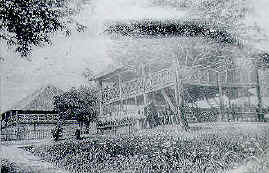
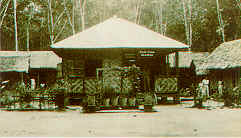
Police Station and residence of members of Sri Menanti Police, Negeri Sembilan in 1874
Bukit Putus Police Station 1874.
Rasah Police Station, Negeri Sembilan in 1879.
Historical Narrative
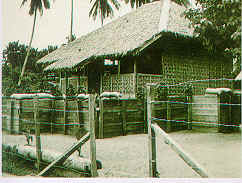
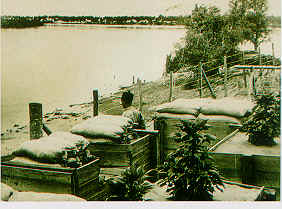
Murray is responsible for forming a police force in Sungai Ujong. Although this police force is small, it is well organized. The Sungai Ujong police force is made up of Sikhs. Police duties are military in nature while Malay members are assigned as revenue collectors. Most of the police stations that were first established were equipped with forts, especially in remote areas.
An important incident that involved the role of the police was the fight in Terachi in 1875. In that incident, a group of Malays rose up against the British colonists but the police crushed them at Bukit Putus in December 1875. The army, which was mainly composed of Gurkhas brought from Melaka, was responsible for breaking the resistance. A police force organization led by two officers, Bird and Skinner, was also involved in the operation.
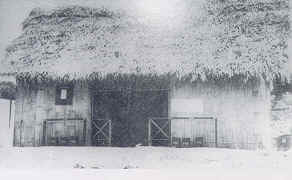
Defense fort and Jempol Police Station 187O
The first European appointed as Negeri Sembilan Police Chief was W . W. Douglas (1881). His position is known as Superintendent of police and prisons, Sungai Ujong. By 1880 the Sungai Ujong police force contained 100 members who were all Malays except for a few Javanese.
Police Station and residence of members of Sri Menanti Police, Negeri Sembilan in 1874
Bukit Putus Police Station 1874.
Rasah Police Station, Negeri Sembilan in 1879.
Negeri Sembilan Contingent Headquarters (old) in Seremban which was officiated by J.W. Simmons (British Resident) Nine States on July 6, 1929
Negeri Sembilan policemen in front of the Kuala Kelawang Police Station in 1930
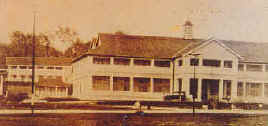
Port Dickson Police District Headquarters in 1928.
The official opening of the Negeri Sembilan Police Contingent Headquarters in Seremban on 6 July 1929
Historical Gallery
Negeri Sembilan Police Force — historical image 2Negeri Sembilan Police Force — historical image 3Negeri Sembilan Police Force — historical image 4Negeri Sembilan Police Force — historical image 5Negeri Sembilan Police Force — historical image 6Negeri Sembilan Police Force — historical image 7Negeri Sembilan Police Force — historical image 8
Historical event
Johor Police Force
Key FactsPeriod: 1882–1939Johor Police Training Center in 1920In 1910, Sultan Ibrahim received a British General Adviser to reorganize the administration of Johor.GP Cuscaden, the first European Police Commissioner began his duties in 1912.Since the reorganization, the Johor Police Force has continued to show progress.Insp Uda bin Awang and members of the J…
Read full historical narrative
Key Facts
Period: 1882–1939
Johor Police Training Center in 1920
In 1910, Sultan Ibrahim received a British General Adviser to reorganize the administration of Johor.
GP Cuscaden, the first European Police Commissioner began his duties in 1912.
Since the reorganization, the Johor Police Force has continued to show progress.
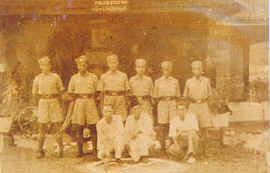
Insp Uda bin Awang and members of the Johor State Police in front of Segamat Police Station, Johor - 1917
Historical Narrative
Johor Police Training Center in 1920
In 1910, Sultan Ibrahim received a British General Adviser to reorganize the administration of Johor. From 1914, the General Counsel was given more powers as a result of the agreement between Johor and Britain. Historical records show that a police force was officially in existence even before the arrival of the English Advisers. The first Police Commissioner was Dato' Bentara Luar. He held the position from 1882. From that date until 1912, the position of Johor Police Commissioner was held by a Malay officer.
GP Cuscaden, the first European Police Commissioner began his duties in 1912. He was given the task of reorganizing the Johor Police Force according to the concept of modern policing. GP Cuscaden was an able officer. In 1915, the Johor Police Force had 16 officers and 540 low-ranking members. There are 4 officers and 44 low-ranking detectives. Cascaden was replaced by M.G. Simpson from 1920.
Since the reorganization, the Johor Police Force has continued to show progress. In 1928, there were more than 60 police stations throughout the State. In 1937, a new "Police Depot" was opened in Johor Bharu. Johor is divided into three police formations called `lingkongan' (Circle) which are Muar, Batu Pahat and Johor Bharu. By the Second World War, the membership of the Johor police force had increased to a total of 1,400 people.
Insp Uda bin Awang and members of the Johor State Police in front of Segamat Police Station, Johor - 1917
Johor police officers and members at the Police Training Center, Johor - 1920
Sergeant Major and some members of the Johor State Police outside the Segamat Police Station building, Johor - 1925
Sergeant Major Abdullah from Segamat Police Station, Johor - 1925
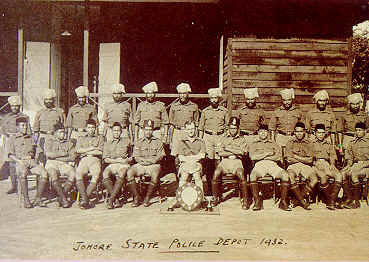
Johor State Police Force in 1932
"Warren Shield" Rifle Shooting Team of the Johor Police Training Center in 1939
Johor State Police Honor Control in 1935
Historical Gallery
Johor Police Force — historical image 2Johor Police Force — historical image 3Johor Police Force — historical image 4Johor Police Force — historical image 5Johor Police Force — historical image 6Johor Police Force — historical image 7Johor Police Force — historical image 8
Historical event
Kedah Police Force
Key FactsPeriod: 1889–1962Group photo after the meeting of the handover of Setoi and Perlis to Siam in front of Balai Besar Lama, Alor Setar, Kedah in 1897.The non-aligned Malay States in the north of Malaya continued to be under Siamese control until 1909.The Kedah Police Force was formed by the Sultan of Kedah with the help of several European officers be…
Read full historical narrative
Key Facts
Period: 1889–1962
Group photo after the meeting of the handover of Setoi and Perlis to Siam in front of Balai Besar Lama, Alor Setar, Kedah in 1897.
The non-aligned Malay States in the north of Malaya continued to be under Siamese control until 1909.
The Kedah Police Force was formed by the Sultan of Kedah with the help of several European officers before 1909.
From 1922, both North and South Kedah Police regions were united.
Parade around Alor Setar Town after the declaration of Perlis and Setoi to Kedah by the King of Siam - 1897.
Historical Narrative
Group photo after the meeting of the handover of Setoi and Perlis to Siam in front of Balai Besar Lama, Alor Setar, Kedah in 1897.
The non-aligned Malay States in the north of Malaya continued to be under Siamese control until 1909. Control over Terengganu was only nominal. With the conclusion of the 1909 agreement, all the Malay states were transferred from Siamese control to British rule.
The Kedah Police Force was formed by the Sultan of Kedah with the help of several European officers before 1909. By 1909, the strength of this police force amounted to 501 people, 260 Malays, 134 Indians, 6 Chinese and 5 Siamese. The Kedah Police Chief at that time was Tunku Ibrahim. The Prince is assisted by Police Commissioner Mitchell who is stationed in Kulim, and Chief Inspector Joyce (Alor Setar). When Mitchell retired his position did not change, the Kedah police administration was divided into two regions, the north and the south. An Assistant Commissioner heads the northern region while Joyce Speers is in the Southern Region. When Tunku Ibrahim became the Deputy Ruler of Kedah, he resigned from his position as Kedah Police Chief.
From 1922, both North and South Kedah Police regions were united. Speers was appointed as Kedah Police Commissioner. He was assisted by A. W. Hamilton as Assistant Commissioner in charge of the Northern area and P.K. Hazlitt in charge of the Southern area of Kedah. This system continued until the state of Kedah was divided into three circles with Alor Setar, Sungai Petani and Kulim in 1929. The State Police Headquarters is located in Alor Setar. When Speers retired the same year A. W . Hamilton was appointed in his place. The strength of the Kedah police force that year was 764 people. Almost all of them are Kedah Malays. A small number of Sikh policemen are used for control duties stationed at Alor Setar.
Before the Second World War, the members of the Kedah police force numbered 225 people.
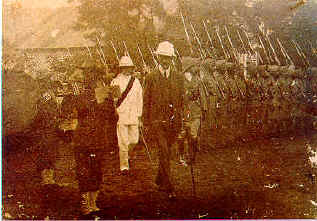
Parade around Alor Setar Town after the declaration of Perlis and Setoi to Kedah by the King of Siam - 1897. Visible on the left and right of the road is a security control team made up of Kedah police officers.
The honor control consisted of the Kedah State police force in 1905
Mr. B.E. Mitchell (in white shirt) together with some members of the Kedah state police in 1909
The guard of honor consisted of members of the Kedah police upon the return of His Majesty the Sultan of Kedah from a visit to England in 1927
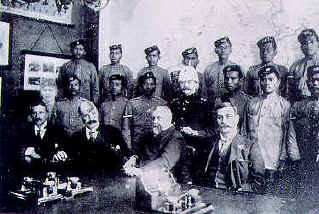
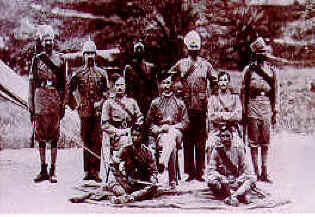
Some of the members of the Kedah Police. Sitting on the far left is Tunku Ibrahim, Kedah Chief of Police in 1911-1914.
B.E. Mitchell, Chief of North Kedah Police in 1889-1910
A.W. Hamilton, Assistant Commissioner of Police in the North of Kedah in 1922
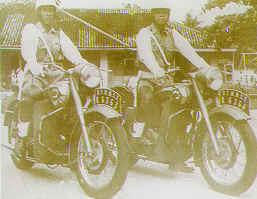
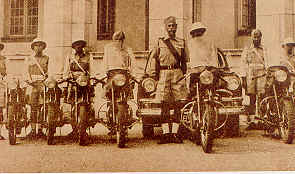
Policemen and bodyguards of His Royal Highness the Sultan of Kedah in 1962 (BSA Golden Flash 650 CC Twin motorcycle)
Sipahi Policemen are marching in front of the Alor Setar Police Station, Kedah in 1922
Now Alor Setar Traffic Police Station, Kedah
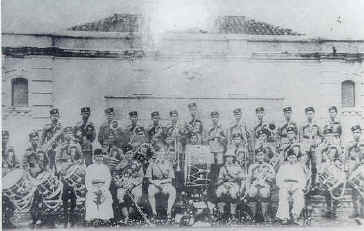
Kedah Police Band in 1938
Sungai Petan Police Station, Kedah
Historical Gallery
Kedah Police Force — historical image 2Kedah Police Force — historical image 3Kedah Police Force — historical image 4Kedah Police Force — historical image 5Kedah Police Force — historical image 6Kedah Police Force — historical image 7Kedah Police Force — historical image 8Kedah Police Force — historical image 9Kedah Police Force — historical image 10Kedah Police Force — historical image 11Kedah Police Force — historical image 12Kedah Police Force — historical image 13
Historical event
Perlis Police Force
Key FactsPeriod: 1909–1946In 1909, the Perlis Police force consisted of 57 members with 30 Malays and 27 Sikhs.Upon his return to Perlis in 1910, he was appointed to head the Malay police with the rank of Inspector.The strength of the police force at that time did not exceed 80 people.Historical NarrativeThe Perlis Police Force is the only police force in M…
Read full historical narrative
Key Facts
Period: 1909–1946
In 1909, the Perlis Police force consisted of 57 members with 30 Malays and 27 Sikhs.
Upon his return to Perlis in 1910, he was appointed to head the Malay police with the rank of Inspector.
The strength of the police force at that time did not exceed 80 people.
Historical Narrative
The Perlis Police Force is the only police force in Malaya that was formed without the help and assistance of European officers.
In 1909, the Perlis Police force consisted of 57 members with 30 Malays and 27 Sikhs. In the same year Encik Mat bin Kassim was sent to Kedah to follow police training under Captain Speers in Kuala Muda.
Upon his return to Perlis in 1910, he was appointed to head the Malay police with the rank of Inspector. The extent of his power and control over the Sikh police cannot be ascertained. However, he is the most senior officer in the Perlis Police Force. In 1914 he was certified as Commander of the Malay Police Force.
Encik Mat bin Kassim is trying to equip and improve the efficiency of the Perlis police force. Discipline and training are emphasized. Wages are increased and corruption is controlled. The effect is that the crime situation in Perlis is reduced.
The strength of the police force at that time did not exceed 80 people. From 1927, Encik Mat Kassim's position was known as Perlis Chief of Police. This situation existed until the Perlis Police Force was merged with the Malayan Union Police Force in 1946. His record of service leading the Perlis Police Force made him unique in the history of the country's policing.
Historical event
Kelantan Police Force
Key FactsPeriod: 1900–1955Kelantan state policemen with Panji-panji in 1922When the Anglo-Siamese Treaty was signed in 1909, Kelantan already had a Malay Police Force under the control of a prince, Tunku Sri Maharaja.From 1910, the position of Superintendent of Police was changed to Chief Police Officer.Anderson strengthened the Kelantan Police Force by emp…
Read full historical narrative
Key Facts
Period: 1900–1955
Kelantan state policemen with Panji-panji in 1922
When the Anglo-Siamese Treaty was signed in 1909, Kelantan already had a Malay Police Force under the control of a prince, Tunku Sri Maharaja.
From 1910, the position of Superintendent of Police was changed to Chief Police Officer.
Anderson strengthened the Kelantan Police Force by emphasizing the pattern of military discipline.
In 1915, he left Malaya with the aim of rejoining the Armed Forces.
Historical Narrative
Kelantan state policemen with Panji-panji in 1922
When the Anglo-Siamese Treaty was signed in 1909, Kelantan already had a Malay Police Force under the control of a prince, Tunku Sri Maharaja. The strength of the team is 268 people. In addition there are also approximately 60 members of the Sikh Police known as the Military Police. This police function as a control member and escort. In 1910 G. Cullen from the Federated Malay States police force was seconded to Kelantan as Police Superintendent with the task of reorganizing the Kelantan Police Force. The Military Police was absorbed into the Kelantan Police force. A Police Training Center was also established. Tunku Sri Maharaja continued to remain as Police Commissioner.
From 1910, the position of Superintendent of Police was changed to Chief Police Officer. G. Cullen led the Kelantan police for 3 years and he helped a lot to develop the force. G. Cullen was replaced by Captain Tomlison and served as Chief Police Officer for one year. On April 28, 1913, Captain H.A. Anderson replaces Tomlison.
Anderson strengthened the Kelantan Police Force by emphasizing the pattern of military discipline. When the 1914 war broke out, he was asked to help organize and organize the volunteer police which was composed of Europeans in Kelantan.
In 1915, he left Malaya with the aim of rejoining the Armed Forces. He served a short time because he fell ill.
During his absence, a revival led by Tok Janggut broke out in Kelantan, especially in Pasir Putih. A policeman with the rank of Sergeant was killed by the Tok Janggut group. The uprising was put down by the British with the help of the Singaporean police.
Anderson retired in 1934 and settled in Kota Bharu. During the Japanese occupation, he was detained in Singapore. After his release, he returned to Kota Bharu and died there on 24 Jan. 1955.
He was succeeded by D. Hillary, after which E.C. Tidy and E.W. Mumford. The strength of the Kelantan Police Force before the Second World War was 388 members.
Capt. Anderson and Kelantan police officers in Kota Bharu in May 1930
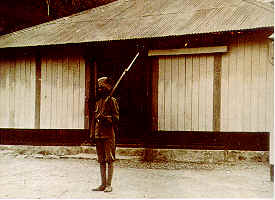
Tangga Bradley Police Station Kuala Krai, Kelantan.
Pengkalan Kubur Police Station, Tumpat, Kelantan in 1904
Balam Police Station, Kelantan in 1900
A view of the Golok River from the front of Pengkalan Kubur Police Station
Kuala Krai Kelantan Police Station in 1900
Historical Gallery
Kelantan Police Force — historical image 2Kelantan Police Force — historical image 3Kelantan Police Force — historical image 4Kelantan Police Force — historical image 5Kelantan Police Force — historical image 6Kelantan Police Force — historical image 7
Historical event
Terengganu Police Force
Key FactsPeriod: 1914–1928In Kuala Terengganu, a police force was already formed in the early twentieth century under the command of Tunku Panglima Besar.In 1916, the Sultan of Terengganu, acting on the advice of the British representative asked the High Commissioner to send a British Police officer to help reorganize the Terengganu Police force.An effectiv…
Read full historical narrative
Key Facts
Period: 1914–1928
In Kuala Terengganu, a police force was already formed in the early twentieth century under the command of Tunku Panglima Besar.
In 1916, the Sultan of Terengganu, acting on the advice of the British representative asked the High Commissioner to send a British Police officer to help reorganize the Terengganu Police force.
An effective step was taken in 1917 when eight village chiefs were appointed with a small group of policemen under them.
Tunku Besar died in 1921.
Since then the Terengganu Police force continues to thrive in line with the progress of the police in other Malay states.
Historical Narrative
Engku Abu Bakar Tengku Sri Wangsa Diraja, Terengganu Police Chief
In Kuala Terengganu, a police force was already formed in the early twentieth century under the command of Tunku Panglima Besar. By 1914, the strength of the Terengganu police force was only 18 people consisting of members with the rank of constable.
In 1916, the Sultan of Terengganu, acting on the advice of the British representative asked the High Commissioner to send a British Police officer to help reorganize the Terengganu Police force. The Sultan's request was not fulfilled due to the outbreak of the First World War at that time.
An effective step was taken in 1917 when eight village chiefs were appointed with a small group of policemen under them. In 1919, the Terengganu treaty was revised, and the Sultan agreed to accept British Advisors like other Malay states. The arrival of the English Advisor also brought reforms to the Terengganu state policing system. This was clearly seen when the strength of the Terengganu Police Force increased by 240 members in 1920. A European police officer was seconded to work in the state. He is E Cheers.
E Cheers who has served with the Johor Police has been given the position of Terengganu Police Commissioner. While Tunku Panglima Besar is appointed as the Chief Commissioner of Police, but the powers of both are the same. Cheers was given cooperation and support in its efforts to reorganize the system and administration of the Terengganu Police force.
Tunku Besar died in 1921. His successor held the position of Malay Commissioner. The English Police Commissioner was given full authority to command and control the force. Cheers was later replaced by M. L. Wynne in October 1923.
Since then the Terengganu Police force continues to thrive in line with the progress of the police in other Malay states. The Terengganu Police Force also used the Sultan to encourage Malays to serve in the police force. A Sultan of Terengganu had been a probationary Sub-Inspector in 1924. In the following year Tengku Muhamad, Sultan Ahmad's son from Pahang was seconded from the Federated Malay States Police Force. Tengku Muhamad was later appointed as Assistant Commissioner. He played an important role in developing the Terengganu police force. By the Second World War, the strength of the Terengganu Police Force increased to 374 members.
Tengku Panglima General Chief Commissioner of Terengganu State
Terengganu Policemen in a parade after returning from the Tok Janggut uprising in 1928
Mr. E. Cheers Terengganu State Police Commissioner in 1920
Mr. M. L. Wynne Terengganu State Police Commissioner in 1923
Historical Gallery
Terengganu Police Force — historical image 2Terengganu Police Force — historical image 3Terengganu Police Force — historical image 4Terengganu Police Force — historical image 5
Historical event
Sarawak Police Force
Key FactsPeriod: 1841–1970'Sarawak Constabulary' on a raft in Meligan 1909 When James Brook was given the authority to rule Sarawak in 1842 (as the King of Sarawak) he established an armed force that had two functions, namely the police and the army responsible for maintaining the peace and security of Sarawak.In 1862, a ranger force of 120 members was esta…
Read full historical narrative
Key Facts
Period: 1841–1970
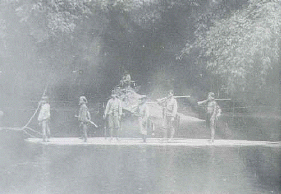
'Sarawak Constabulary' on a raft in Meligan 1909 When James Brook was given the authority to rule Sarawak in 1842 (as the King of Sarawak) he established an armed force that had two functions, namely the police and the army responsible for maintaining the peace and security of Sarawak.
In 1862, a ranger force of 120 members was established in Kuching under the command of Major W.H.
Sarawak Police Uniform 1841-1965
Seeing the effectiveness and orderliness of the police forces that had been established in the Straits Settlements, Federated Malay States and Non-Federated Malay States, finally in 1932 a more organized and specialized police force was formed named "Sarawak Constabulary".
By 1940, the Sarawak Constabulary was split into two units.
Historical Narrative
'Sarawak Constabulary' on a raft in Meligan 1909 When James Brook was given the authority to rule Sarawak in 1842 (as the King of Sarawak) he established an armed force that had two functions, namely the police and the army responsible for maintaining the peace and security of Sarawak. He also established small towns in strategic places in the country which were guarded by garrisons. From these garrison guards the Sarawak police force was established. However, in 1932 these two forces were merged and given a new name, Sarawak Constabulary. The concept of the Sarawak Constabulary is the same as the North Borneo Armed Constabulary established in Sabah. The role of this force is to protect the interests of King Brooke from being challenged, especially by the rise of the indigenous people of Sarawak who are very unhappy with the rule of an Englishman in their homeland.
In 1862, a ranger force of 120 members was established in Kuching under the command of Major W.H. Rodway. Its members are taken from among the bumiputras of Sarawak in addition to Indians and Javanese. This Ranger team has a training center in Kuching. The service of the ranger team to the Brooke Government in pacifying Sarawak is great. This includes the wars against Rentap (1857-1861), Julau Dayak (1856), Kayan Besar (1863), Katibas (1868-1871) and Ulu Ai (1875). The first Sarawak Ranger Commandant was A. Rodway (1868-1870) and then F. Walter (1870-1871), G.H. Becehus (1871-1875), W.H. Rodway (1877-1883), H.M. Peck (1884-1886), F.K.I. (1886-1894), G.L.B. Killick (1899-1900), G. Wilson (1902-1903), Sir Percy Cunnyghame (1903-1904) and J . Whaler Aldright (1903-1905) . The last Ranger Commandant was R. E. Lesueur (1923-1932).
Sarawak Police Uniform 1841-1965
Seeing the effectiveness and orderliness of the police forces that had been established in the Straits Settlements, Federated Malay States and Non-Federated Malay States, finally in 1932 a more organized and specialized police force was formed named "Sarawak Constabulary". Its membership at that time was only 859 people.
Meanwhile, the Sarawak Armed Constabulary increased its membership to 1000 members. The task of village spy has also been taken over by members of the Sarawak Constabulary. What is clear is that the Sarawak Constabulary is still playing the role of the police and the army, especially as it prepares to curb any rebellion by the natives of Sarawak.
By 1940, the Sarawak Constabulary was split into two units. Unit A consisting of 900 members of various ranks is responsible for carrying out general police duties, providing control and armed escort at the main stations in the state. Unit B also contains three Dayak platoons, consisting of 100 members who are given paramilitary duties, which is like the current Forest Police Force.
When the Second World War broke out (1940), the Sarawak Constabulary also fought to defend Sarawak from the Japanese attack, but the strength and equipment of the Japanese army turned out to be superior to the defense of Sarawak. Within a few days, Sarawak fell into the hands of the Japanese and with that the Sarawak Constabulary was also disbanded. The Japanese government formed its own police force. Many members of the Sarawak Constabulary continued their service under the Japanese Police.
In 1946 the British government officially took over the government of Sarawak and placed it under the Colonial Office. The Sarawak police force at that time numbered 1079 people. With the change of administration, Sarawak experienced several changes. The Sarawak Constabulary team was modernized in various aspects including the training system, equipment and equipment of the team. What is interesting is that in 1955 the Constabulary Ordinance (1955) was issued in Sarawak.
When Sarawak achieved independence through Malaysia in 1963, the Sarawak Armed Constabulary was also absorbed into the PDRM.
'Sarawak Rangers' birthday parade and presentation of general service medals in 1929
The 'Sarawak Rangers' paraded the flag in December 1931.
Palace Guard 1954
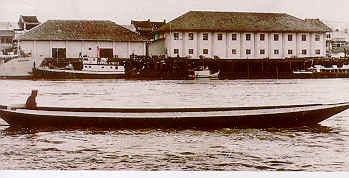
A long boat used by the Sarawak Marine Police in 1966
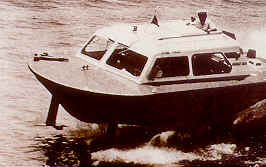
A speedboat used by the Sarawak Marine Police in 1970
Hydrophil submitted by YB. Tan Sri Temenggong Jugah Ah Bareng to the Sarawak PDRM in 1965
Historical Gallery
Sarawak Police Force — historical image 2Sarawak Police Force — historical image 3Sarawak Police Force — historical image 4Sarawak Police Force — historical image 5Sarawak Police Force — historical image 6Sarawak Police Force — historical image 7Sarawak Police Force — historical image 8
Historical event
Sabah Police Force
Key FactsPeriod: 1700s–1967The local police 'Flight Squad' with his signature in the early 1700sIn 1888, Sabah, Sarawak and Brunei were placed under the army of the British North Borneo Chartered Company.In 1882 the North Borneo Armed Constabulary team planned to hire 200 members but the North Borneo Chartered Company Board approved only 50 and this left th…
Read full historical narrative
Key Facts
Period: 1700s–1967
The local police 'Flight Squad' with his signature in the early 1700s
In 1888, Sabah, Sarawak and Brunei were placed under the army of the British North Borneo Chartered Company.
In 1882 the North Borneo Armed Constabulary team planned to hire 200 members but the North Borneo Chartered Company Board approved only 50 and this left the Captain Harrington unhappy and he was replaced by Captain A.M.
Under Captain A.M.
Matheson, 1930 Sabah Police Commissioner
Historical Narrative
The local police 'Flight Squad' with his signature in the early 1700s
In 1888, Sabah, Sarawak and Brunei were placed under the army of the British North Borneo Chartered Company. To maintain order and security, especially from pirate disturbances that often terrorize Sabah's coast, a police force was formed in 1881. The force known as the North Borneo Armed Constabulary was founded by Captain Harrington, the former Riffle Brigade. He was the brother of Lt. Col C.H. Harrington who was the Commander of the North Borneo Armed Constabulary from 1889 to 1921. The commander was the highest ruler of the Sabah police force at the time. The members of the North Borneo Armed Constabulary police force were Sikh and Pattan who were brought from India. Their service and loyalty were greatly favored by the British.
In 1882 the North Borneo Armed Constabulary team planned to hire 200 members but the North Borneo Chartered Company Board approved only 50 and this left the Captain Harrington unhappy and he was replaced by Captain A.M. de Fontaine in 1883.
Under Captain A.M. de Fontaine, the North Borneo Armed Constabulary was revamped and restructured to accommodate the needs and wishes of the local conditions. The North Borneo Armed Constabulary was no longer made up of members from India but also had local indigenous members consisting of the Dayak, Somalis and Malay Brunei. The total number of members of the North Borneo Armed Constabulary in 1883 was 153.
The young people of the indigenous people were recruited to the North Borneo Armed Constabulary because of their ability to carry out their duties in North Borneo, especially since they have understood and understood the local customs. The number of local children was initially only 15.
The British officer is an Englishman. The recruit was conducted by an Englishman named Prayer and Davis. The Somalis and Malay people were brought from Labuan and the Strait states alongside a small number of Dayak people from Sarawak.
The duties and responsibilities of the North Borneo Armed Constabulary cover the duties of police and military. In addition to enforcing laws, they maintain security and order and preserve state sovereignty and eradicate pirates in the sea, investigate criminal cases and eliminate any rebellion or invasion.
Matheson, 1930 Sabah Police Commissioner
Mr. R.T.M. Henry QRM, C.P.M., P.K.J., Sabah Police Commissioner 21 November 1965
The weapons used by members of the North Borneo Armed Constabulary at that time were the Snider type rifle Enfields. The same type rifle was also given to members of the Somalis. The members of the Malay and Dayak nations received the Snit Carbines rifle.
The rise of indigenous nationalism in North Borneo existed since 1896. Many armed resistance occurred. Among them was the resistance led by Antanom. This Murut hero denied the British tax on them.
Two years later (1898) another Sabah native emerged as the leader of the uprising against the British. The persistent and brave fighter was named Mat Salleh.
When Governor Humphreys took over the administration of North Borneo (1929), he paid serious attention to the expansion, modernization, and strengthening the North Borneo Armed Constabulary to meet the needs and current atmosphere.
The position of commander, the top commander of the North Borneo Armed Constabulary, was abolished and replaced by the name of the Police Commissioner. The Police Commissioner's position continued to be maintained until today.
When the Second World War erupted, Japan managed to occupy North Borneo in 1942. Before that, the Japanese army had to face the North Borneo Armed Constabulary. The more advanced Japanese army in equipment and weapons eventually defeated the North Borneo Armed Constabulary defense which was not only lacking in terms of membership but also not enough supplies. Their struggle was more resilient with passion and courage. However, they were not easily defeated.
After Japan lost, the British colonial government governed North Borneo reorganized the police organization and system there. A North Borneo Police Force (North Borneo Police Force) was formed in 1946 replacing the dissolved North Borneo Armed Constabulary. All officers and members of the North Borneo Armed Constabulary were incorporated into this new force. In this connection, the recruitment of new members was carried out rapidly.
Sikh Police Cavalry Contingent at the end of the 1890s
Police rackets in Jesselton (now known as Kota Kinabalu)
The then Police Commissioner was D. Matheson, an experienced officer from England. He held the position until December 1, 1954. During his tenure, D. Matheson worked hard to modernize the North Borneo Police Force. He also reorganized the administrative system that exists in the Sabah component today. In this case, the police area that was formerly divided into two divisions, the West Coast and the East Coast was further divided into four divisions, the West Coast, the Tawau and Sandakan, which were in accordance with the state's public administration system. Each division of the police division was led by the Divisional Superintendent of the Police. The division of the police division was then divided into police district areas led by a District Police Chief. Then each district was divided into police station areas. The police stations were led by the Police Chief of the Police. This system continues until now.
From 1963, the North Borneo Police Force was incorporated into the Royal Malaysian Police Force, which was responsible for the Chief of Police. The team's instructions and policies were made by the Chief of Police, Kuala Lumpur. The Sabah Police Force was considered a formation of police force in the states of Peninsular Malaysia but was still maintained as the Sabah Component as in Sarawak. This is also the Sabah Component Police subject to the Police Act 1967.
"The officers were certified and without a certificate, the Sandakan Police Force 'detachment' in 1913."
The fire extinguishing service is also part of the police duties. There are firefighters in the Labuan fire depot.
Sabah local police officer
Sabah Police Force in early 1900
The Honorary Control by the North Borneo Police Force during the visit of YTM Tunku Abdul Rahman Putra Alhaj the Prime Minister of Malaya to North Borneo on 3 January 1959
'Home Guard' in the 1960s
Sabah Police officers in the 1950s
Sikh police contingent in a march on Charter Day in Sandakan in 1891
The memorial was established in Tambunan to commemorate Mat Salleh
Police Reserve Unit undergo training in Kota Kinabalu
Local hero of North Borneo Mat Salleh
Court of Director' - British North Borneo Company with the Dayak Police Contingent participating in the Diamond Jublee celebration
Mr. West Ridgeway, Chairman of Chartered Company, inspected the honorary line of North Borneo police officers in Jesselton in 1915
Prison in Batu Tiga, Jesselton 1915
Commanders and officers of the British North Borneo Police Force in Sandakan in 1891
Historical Gallery
Sabah Police Force — historical image 2Sabah Police Force — historical image 3Sabah Police Force — historical image 4Sabah Police Force — historical image 5Sabah Police Force — historical image 6Sabah Police Force — historical image 7Sabah Police Force — historical image 8Sabah Police Force — historical image 9Sabah Police Force — historical image 10Sabah Police Force — historical image 11Sabah Police Force — historical image 12Sabah Police Force — historical image 13Sabah Police Force — historical image 14Sabah Police Force — historical image 15Sabah Police Force — historical image 16Sabah Police Force — historical image 17Sabah Police Force — historical image 18Sabah Police Force — historical image 19Sabah Police Force — historical image 20
1896–1945
Consolidation and Wartime
State forces were consolidated in the Federated Malay States before the Second World War and Japanese occupation transformed the security landscape.
Historical event
Federated Malay States Police Force
Key FactsPeriod: 1896–1945The year 1874 was an important moment in the country's history because of the beginning of the English Resident system in the states of Malaya which was pioneered by the state of Perak.The formation unites the police forces of the states into the Federated Malay States Police Force.The Federated Malay States Police Force is under i…
Read full historical narrative
Key Facts
Period: 1896–1945
The year 1874 was an important moment in the country's history because of the beginning of the English Resident system in the states of Malaya which was pioneered by the state of Perak.
The formation unites the police forces of the states into the Federated Malay States Police Force.
The Federated Malay States Police Force is under its highest authority, which is the Commissioner of Police.
With the establishment of Malay States Guides under Colonel Walker in 1896 the strength of six infantry companies and two artillery companies (900 members).
The first year of existence of the Federated Malay States Police recorded a total of approximately 2000 members.
Historical Narrative
Malay policemen from the United Malay States Force at the beginning of British rule
The year 1874 was an important moment in the country's history because of the beginning of the English Resident system in the states of Malaya which was pioneered by the state of Perak. In 1892, the idea of the Federated Malay States was born, the four states were united in a Federation.
The formation unites the police forces of the states into the Federated Malay States Police Force. The existence of the police force coincided with the formation of the Federated Malay States which came into effect on 1 July 1896.
According to the Constitution of the Federated Malay States, the Police, Customs, Survey, Labor and Defense Departments are placed under the jurisdiction of the Central Government headquartered in Kuala Lumpur.
The Federated Malay States Police Force is under its highest authority, which is the Commissioner of Police. Perak, Pahang, Selangor and Negeri Sembilan are made into Police Contingents and led by a State Police Chief (Chief Police Officers). Although the Police Commissioner of the Federated Malay States is responsible for the administration and supervision of the police force, it is under the control and direction of the Secretary General of the Federated Malay States. Section 3, Police Force Enactment (1924) mentions that,
"The Superintendent and administration of the Police Force shall be in the hands of the Commissioner and subject to the orders and control of the Chief Secretary".
The first person to be appointed as the Federated Malay States Police Commissioner was Captain H. C. Syers, the Selangor State Police Superintendent. Syers moved the State Police Headquarters from Klang to Kuala Lumpur (now Bukit Aman) and kept Bluff Road Hill as the Federated Malay States Police Administration Center. His position as Selangor Police Superintendent was replaced by Christian Wagner.
Under Captain H.C. Syers, the Federal Malay State Police experienced some rapid and encouraging changes. To create a sense of unity, blue uniforms were introduced. Each state is distinguished by the shape of buttons and badges.
Syers took the initiative by reorganizing the police administration in Perak. The Perak Police Contingent is led by a Chief of Police with the rank of Deputy Commissioner of Police who fully takes over the role of the Sikh force in Perak which is considered no longer part of the police force but Malay States Guides. The Perak contingent at that time had a total of 842 members, 15 European officers, 472 Sikh and Pathan officers and members, 14 orderlies and 302 low-ranking officers and Malay constables. The members of the Selangor Contingent are six European officers, 32 Pathans and 500 low-ranking officers and Malay constables.
With the establishment of Malay States Guides under Colonel Walker in 1896 the strength of six infantry companies and two artillery companies (900 members). All military tasks that used to be part of the duties and responsibilities of the Federated Malay States Police Force were taken over by the force.
The Pahang Contingent Police Chief is Duff and the force has 245 members. F.W. Talbot led the Negeri Sembilan Contingent. Under him there are two Inspectors, 56 Sikh members and 250 low-ranking officers and Malay constables.
The first year of existence of the Federated Malay States Police recorded a total of approximately 2000 members. The problem that existed until 1903 was that the merger of the police was still loose, the Resident also had power in the police administration of each state. The Commissioner of Police in Bluff Road (now Bukit Aman) does not have full authority, except as ``Inspecting Officer'' only.
A photo of the Federated Malay States Police Inspector taken in 1933
By 1902, the strength of the police force was 2160 people, namely three Deputy Commissioners, two Assistant Commissioners, 25 inspectors, two Bumiputera Officers, 1961 low-ranking officers and constables, 93 detectives and 14 orderlies. Meanwhile, members of the Selangor and Pahang Contingent police are armed with `Martini-Enfield Converted Carbines'. Other states received `Martini rifles' and carbines.
In the following year, 1903, the Federated Malay States Police Force came under the authority and control of the Police Commissioner. This effort was made by H.L. Talbot who sought to transfer power and state level to the center through the enforcement of the Police Force Enactment 1903.
One problem faced by the government of the Federated Malay States Police Force at that time was to get trained members. Before that the members were usually recruited from the Indian military forces. To overcome the problem a Training Center (Depot) was established in the Bluff Road compound in October 1903.
In order to change the view of the police and encourage the Malays to serve with the police force, the British used the values of loyalty to the King found in the Malays. For that Raja Alang lskandar, the prince of Sultan Idris from Perak, an Oxford graduate who worked in the Taiping Secretariat was appointed as Assistant Commissioner on 1 August 1905 with the approval of His Majesty the Sultan of Perak.
Raja Alang Iskandar was the first Malay to be given the highest rank by the British. He is an enthusiastic prince with a pleasant demeanor. He was then stationed at the Police Depot and given responsibility for the recruitment of Malay police officers. Raja Alang Iskandar tela carried out various efforts to attract the interest of the Malays to serve in the police force. After 37 years, this training center was moved to Riffle Range Road (Jalan Semarak), which is now known as PULAPOL (Police Training Center).
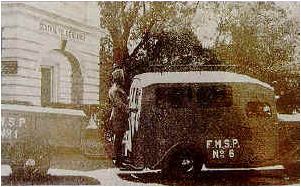
Vehicles used by the Federated Malay States Police Force
Members of the Federated Malay States Police (FMS) in 1936
By 1908 some progress was clearly visible with the Contingent and District level organization of the police being organized. The depot is getting more complete. The newly established detective branch and Registrar of Criminal Records are running smoothly. Probation officers were brought over from England.
When Talbot died on 31 August 1909, Douglas who had been acting Commissioner of Police since Talbot was ill was retained in the post. Douglas was the Perak Police Chief since 1897.
In 1911, the members of the Allied Malay States Force continued to increase. Within ten years the membership increased from 2138 people to 3241 people. The number of European officers also increased from 41 people to 72 people. The problem faced by the police at that time was gambling among the Chinese and also crimes related to opium. But with the efficiency of the police force the situation can be controlled.
At this time there was also a Police Force Enactment which was enforced on 9 January 1924. This enactment was more organized, explaining the roles and duties and responsibilities of the Federated Malay States police.
With the outbreak of the Second World War and the fall of the whole of Malaya to the Japanese, the Allied States Police was automatically disbanded. The last Chief of Police, E. Bagot also fled to Singapore after the British defense force was unable to resist the advance of the Japanese army. When Singapore also fell into Japanese hands, E. Bagot was also captured.
Guard of Honor at the Selangor Club Field by the Federated Malay States Police (FMS)
HJ. Mohamad Bin Rahmat, Detective Sergeant (No. 1, F.M.S. Police)
Historical Gallery
Federated Malay States Police Force — historical image 2Federated Malay States Police Force — historical image 3Federated Malay States Police Force — historical image 4Federated Malay States Police Force — historical image 5Federated Malay States Police Force — historical image 6
Historical event
Japanese Occupation and the Collapse of the Police Force
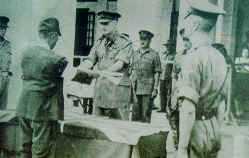
Key FactsPeriod: 1942–1945Picture Shows General Itakagi Sends his Sword to Lieutenant General Messery, the Commander of the `Command' of Malaya followed by the other Japanese Army officers in the ceremony of the handover of Japanese swords at Victoria Institution, Kuala Lumpur on 22 February 1946.At the same time, internal threats from anti-British groups h…
Read full historical narrative
Key Facts
Period: 1942–1945
Picture Shows General Itakagi Sends his Sword to Lieutenant General Messery, the Commander of the `Command' of Malaya followed by the other Japanese Army officers in the ceremony of the handover of Japanese swords at Victoria Institution, Kuala Lumpur on 22 February 1946.
At the same time, internal threats from anti-British groups have increased subversive activities.
On 9 December 1941, the Japanese army landed in Kelantan and Terengganu.
Japanese officials were handed over the Power Sword after the allied forces bombed Hiroshima and Nagasaki in 1945.
Historical Narrative
Picture Shows General Itakagi Sends his Sword to Lieutenant General Messery, the Commander of the `Command' of Malaya followed by the other Japanese Army officers in the ceremony of the handover of Japanese swords at Victoria Institution, Kuala Lumpur on 22 February 1946. The Second World War erupted in 1939 and the situation in Malaya became worse when the Japanese conquered the Indo-China area. Minimum measures were taken by the British Government to defend Malaya.
The Chief of the Strait Police A.H. Dickinson has been appointed as the Public Security Officer for the entire Malaya. He is responsible for organizing the defense of Malaya to face the threat of Japanese military attacks.
In Selangor and Negeri Sembilan, the Auxilliary Police Force was established, and additional constables were taken to strengthen the Police Force. The police in Kedah, Perak and Kelantan were ordered to carry out patrols and control in the border areas of Malaya/Thailand.
At the same time, internal threats from anti-British groups have increased subversive activities. The anti-British campaign was carried out primarily through two newspapers owned by the PKM, namely "EMANCIPATION NEWS" clan "VANGUARD NEWS". On Labor Day 1 May 1940 a massive assembly planned by the PKM in Singapore was able to be broken down by the police by preventing the departure of workers to a designated place.
On 9 December 1941, the Japanese army landed in Kelantan and Terengganu. The Japanese army's advance was unstable and even the police force had split. Singapore's fall to the Japanese hands marked the disappearance of the Strait, Associated Malay States and Associated Non-Associated States.
The period of Japanese occupation was a "great era" in the development of police institutions in Malaya. The Japanese government established a military administration in Malaya. The police force continued to function but was used as a tool of suppression in the Japanese iron-coat rule system.
The Japanese occupation period had two major impacts on the development of the Police institutions in Malaya:
The Japanese occupation has shown that the locals are able to carry out policing duties without the leadership of the English officers. The system of stratification of police officers based on separation between foreign officers and local officers cannot be continued after the end of the Japanese occupation.
The Japanese feelings of hatred towards the Chinese have somehow led to a conflict between the Chinese and the Malays in Malaya. At that time, the marginalized Chinese fled the forest to enter the Malayan Peoples Anti Japanese Army (MPAJA) forces founded by the communists. The police force that hunted the guerrillas consisted mostly of the Malays. The direct impact of this situation was initiated after the Japanese army's surrender. It took the British for more than two weeks to reestablish Malaya. During this transition period, guerrillas had emerged from the forest and took over power in several places. They had taken this opportunity to retaliate.
Japanese officials were handed over the Power Sword after the allied forces bombed Hiroshima and Nagasaki in 1945. The incident was recorded in Singapore.
Historical Gallery
Japanese Occupation and the Collapse of the Police Force — historical image 2
1945–1953
Rebuilding and the Emergency
The force was rebuilt after the war and became a front-line institution against armed threats during the Emergency.
Historical event
Civil Affairs Police Force (CAPF)
Key FactsPeriod: 1945–1948Gurnay Road Police Training Center in 1945The Japanese army's surrender in August 1945 was followed by the formation of the British Military Administration (BMA) to govern Malaya.As an initial step to restore the police institution in Malaya, intensive training courses were initiated at the Kuala Lumpur Police Depot.The Kuala Lumpu…
Read full historical narrative
Key Facts
Period: 1945–1948
Gurnay Road Police Training Center in 1945
The Japanese army's surrender in August 1945 was followed by the formation of the British Military Administration (BMA) to govern Malaya.
As an initial step to restore the police institution in Malaya, intensive training courses were initiated at the Kuala Lumpur Police Depot.
The Kuala Lumpur Gurney Road Police Training Team participated in the 1950 victory march
Police Training Center, Gurney Road now Jalan Semarak) in 1945
Historical Narrative
Gurnay Road Police Training Center in 1945
The Japanese army's surrender in August 1945 was followed by the formation of the British Military Administration (BMA) to govern Malaya. The "Civil Affair Police Force" (CAPF) was formed in Malaya to carry out policing duties. H.B. Longworthy was the head of the team. The formation of this team in September 1945 marked a significant transition point in the history of the development of police institutions in Malaya. It was the first time that a single police force with a central administration was established to cover the rest of Malaya.
As an initial step to restore the police institution in Malaya, intensive training courses were initiated at the Kuala Lumpur Police Depot. By 1946, a total of 1,512 police officers from all over Malaya had undergone refresher courses in Kuala Lumpur. The recruitment of new recruits began in the first week of January 1946. A total of 700 new members were trained to undergo training, with 500 officers at the Kuala Lumpur Police Depot and 200 officers at the Johor Bahru Police Depot. The recruitment was very encouraging, up to 85 percent of the application was rejected.
The Kuala Lumpur Gurney Road Police Training Team participated in the 1950 victory march
Police Training Center, Gurney Road now Jalan Semarak) in 1945
Federation of Malaya Police in a march in Taiping in 1953
The members of the Federation of Malaya Police Force were training at the Police Training Center, Jalan Gurney Kuala Lumpur in 1945
Malay Federal Police officers were on duty in the question office in 1950
Historical Gallery
Civil Affairs Police Force (CAPF) — historical image 2Civil Affairs Police Force (CAPF) — historical image 3Civil Affairs Police Force (CAPF) — historical image 4Civil Affairs Police Force (CAPF) — historical image 5Civil Affairs Police Force (CAPF) — historical image 6
Historical event
Malayan Union Police Force
Key FactsPeriod: 1946–1948In late 1945 and early 1946 the British attempted to establish the "Malayan Union" constitution that had been planned in London.The defense trainer walked away from the hostel to practiceLegal education is provided during trainingHistorical NarrativeThe defense trainer walked away from the hostel to practiceIn late 1945 and early 1…
Read full historical narrative
Key Facts
Period: 1946–1948
In late 1945 and early 1946 the British attempted to establish the "Malayan Union" constitution that had been planned in London.
The defense trainer walked away from the hostel to practice
Legal education is provided during training
Historical Narrative
The defense trainer walked away from the hostel to practice
In late 1945 and early 1946 the British attempted to establish the "Malayan Union" constitution that had been planned in London. Despite strong opposition to this plan that was considered an attempt to convert the position of the Malay states to a colony, the plan was implemented on April 1, 1946. In line with this development, on the same date the name "Civil Affairs Police Force, Peninsular Malay Peninsula" was changed to the Malayan Union Police Force. Its staff, policy, and organization were an extension of what was founded under CAPE H.B. Longworthy was appointed as Police and his deputy was D.P. MacNamara.
Legal education is provided during training
Malayan Union Police Officer is undergoing training
The training of the use of the weapons and the control of the weapons is also provided.
Malayan Union Police officers were given training
Historical Gallery
Malayan Union Police Force — historical image 2Malayan Union Police Force — historical image 3Malayan Union Police Force — historical image 4Malayan Union Police Force — historical image 5
Historical event
The Gray Era
Key FactsPeriod: 1948–1952On 29 June 1948, Sir Edward Gent was reassigned to England.Sir Henry Gurney was killed in a communist attack on his way to Fraser Hill on October 6, 1951.Gray began his duties on 17 August 1948.Gray retired in January 1952.The 'Special Constable' team was checking vehicles on one of the roads in 1950Historical NarrativeOn 29 June 1…
Read full historical narrative
Key Facts
Period: 1948–1952
On 29 June 1948, Sir Edward Gent was reassigned to England.
Sir Henry Gurney was killed in a communist attack on his way to Fraser Hill on October 6, 1951.
Gray began his duties on 17 August 1948.
Gray retired in January 1952.
The 'Special Constable' team was checking vehicles on one of the roads in 1950
Historical Narrative
On 29 June 1948, Sir Edward Gent was reassigned to England. This was followed by the resignation by Langworthy.
Gent was replaced by Sir Henry Gurney and Langworthy was replaced by Colonel Nieol Gray. At that time the Malayan Union Police Force was renamed to the Malayan Federation Police Force. Sir Henry Gurney took two very important decisions for the development of the fight against the threat of communist terrorists. First, the military would not be given full responsibility for the fight against communists. For him this was a political ideological war and he believed that what needed was military support for a political war. The second decision made by Gurney was to launch a redevelopment project for the Chinese slums from the area of the forest edge. These were 600,000 people, and most of them had fled the cities during the Japanese occupation.
Sir Henry Gurney was killed in a communist attack on his way to Fraser Hill on October 6, 1951.
Gray began his duties on 17 August 1948. He faced a very difficult and challenging task. He had to expand and advance the Federation of Malaya Police Force as soon as possible to counter the communist threat. The steps taken by Gray are as follows:
The position of Director of the Crime Intelligence Branch has been changed to Deputy Commissioner who heads two branches, namely the Special Branch and Crime Branch. Each branch is headed by an Assistant Commissioner.
The Deputy Commissioner's position has been established to further streamline the administration of the team.
In accordance with the efforts, several new branches have been established under the Management of the Commissioner and the branches are:
Personnel
Transportation
Special Police and Additional Police
`Q' (including housing, weapons, supplies, and equipment)
Gray retired in January 1952. During his tenure Gray had successfully formed a strong enough police force in terms of the number of personnel and equipment. During his tenure he had faced various issues such as disagreements among officers who had long served with the "outsiders" group brought in to serve in the team; the issue of `Armour Plating' which led to a contentious dispute between him and the farmers and miners; a disagreement between him and Briggs. Gray disagreed with Briggs' proposal to split the police force into two divisions, namely the regular Police Force and the Guardian Force.
The police force was on the way to the killings of Sir Henry Gurney
The 'Special Constable' team was checking vehicles on one of the roads in 1950
Historical Gallery
The Gray Era — historical image 2The Gray Era — historical image 3The Gray Era — historical image 4The Gray Era — historical image 5
Historical event
The Emergency
Key FactsPeriod: 1948–1960Chin Peng's PKM (who took over from Loi Teck who disappeared with a sum of money) launched violence in the middle of 1948.After the situation worsened, Sir Edward Gent declared a state of emergency in the country from 1948.Since the rebellious problem is a domestic problem, the Federal Police of Malaya is given the responsibility t…
Read full historical narrative
Key Facts
Period: 1948–1960
Chin Peng's PKM (who took over from Loi Teck who disappeared with a sum of money) launched violence in the middle of 1948.
After the situation worsened, Sir Edward Gent declared a state of emergency in the country from 1948.
Since the rebellious problem is a domestic problem, the Federal Police of Malaya is given the responsibility to control it.
Historical Narrative
After the Japanese army surrendered, the communist guerrillas removed from the forest and took over power in several areas. However, in the following weeks the British Army (BMA) administration took over power for the British government. At the same time the Malayan Peoples Anti Japanese Army (MPAJA) was dissolved. Its members of 6,800 people received $350/- in cash during their surrender.
In this regard, the Communist Party (PKM) was trying to establish a communist state in Malaya. With that, the PKM members began to resist various political, youth, and trade unions, while also active in the still-halal PKM. After receiving instructions from the Communist Party and feeling that the political means of the cause had failed, the PKM changed its pattern of struggle with armed uprisings, which was in line with the principle of Mao Tse Tung's struggle, which was more confident in the armed violent struggle.
Chin Peng's PKM (who took over from Loi Teck who disappeared with a sum of money) launched violence in the middle of 1948. They killed European colonial managers, destroyed rubber trees and mines, attacked police stations and security forces. To cripple the economy of Malaya, they carried out an operation called the "Bush Earth".
After the situation worsened, Sir Edward Gent declared a state of emergency in the country from 1948. PKM was also banned.
The government has taken several steps to combat communism throughout the country. One major step is to coordinate military movements, relocate the Chinese to new villages, introduce identity cards, curfews, conduct neural and psychological operations, as well as increase the effectiveness of intellectual gathering of communism by establishing a Special Branch placed under the control of the police force.
Since the rebellious problem is a domestic problem, the Federal Police of Malaya is given the responsibility to control it. At the height of the communist rise (1950), the Police Force with a force of 161,281 people consisting of 31,164 permanent police officers, 44,117 special police officers and 86,000 aid police officers is the largest security force because the army only has 10 infantry battalions (2 British Army battalions, 5 Gurkha Army battalions, and 3 Malay Army battalions).
The Police Force acted and played a crucial role in planning strategies against communists. The Police Force hunted and eliminated communists in the forest, in villages, and even in the city. In an effort to succeed in the fight against communists, the Special Branch, as the country's main intelligence body, has acted tirelessly and efficiently. The police also played a crucial role in succeeding in the nuclear war against communists. The role of the police force in the time of emergency is very clear to the number of members who died, which is 1,346 compared to the rest of the security forces, only 519. After feeling very weak, the PKM has withdrawn the remaining troops to the border areas of the Federation of Malaya - Thailand. From there, the PKM has tried to gather and restore its strength.
The Marine Police Force is conducting an inspection of a fishing boat
Key FactsPeriod: 1948–1951The members of the 'Jungle Squad' during the emergency were checking the vehicles that were passing through a roadblock.To address the problem of internal rebellion and hunting for communist terrorists in the forest a military-based force was formed in 1948 and named the "Flying Squad".In 1951, the "Jungle Squad" was strengthened a…
Read full historical narrative
Key Facts
Period: 1948–1951
The members of the 'Jungle Squad' during the emergency were checking the vehicles that were passing through a roadblock.
To address the problem of internal rebellion and hunting for communist terrorists in the forest a military-based force was formed in 1948 and named the "Flying Squad".
In 1951, the "Jungle Squad" was strengthened and further expanded.
Historical Narrative
The members of the 'Jungle Squad' during the emergency were checking the vehicles that were passing through a roadblock. The police-centric concept of para-tentera was born with a modern police institution on 25 March 1807. The police forces formed later carried out the duties of police and military. Similarly, the "Malay States Guides" was formed in 1826. In 1948, the Communist Party of Malaya (PKM) declared its first armed uprising. The PKM intensified its military movement throughout the country. They attacked police stations, killed and injured people who did not support the communist struggle. The PKM also destroyed public property with the aim of paralyzing the country's economy. The three strategies of the PKM are also to achieve their goals are:
FIRST : Weakened and destroyed the Malay Peninsula by "Wind-wind Operation" on the fields and mines;
SECOND : Maintain independent areas;
THIRD: Leading the rebellion through the liberation army. With these efforts, the PKM will be able to unite the independent areas to form a Communist Republic.
To address the problem of internal rebellion and hunting for communist terrorists in the forest a military-based force was formed in 1948 and named the "Flying Squad". Since it was not practicable and appropriate, the name of the force was changed to the "Jungle Squad" in line with its role in combating communist terrorists in the wilderness. The "Jungle Squad" was placed under the direction of the District Police Chief with a force of between 15-20 members per unit. One unit was placed in each district. Although the membership of the force was small, the role played was very proud: The responsibility given to the force was so brilliant and enthusiastic. This had given such a great blow to communist terrorists.
In 1951, the "Jungle Squad" was strengthened and further expanded. Its name was also changed to the "Jungle Company".
Historical Gallery
Jungle Squad — historical image 2
Historical event
General Sir Gerald Templer and Colonel Arthur E. Young
Key FactsPeriod: 1952–1953The British government in London has chosen General Sir Gerald Templer to replace Sir Henry Gurney.In May 1952 the new form of organization for the administration of the Malayan Federation Police Force was announced by Col.The ready-to-service badge was launched by Col.Col.Sir Gerald Templer was accompanied by Police Commissioner C…
Read full historical narrative
Key Facts
Period: 1952–1953
The British government in London has chosen General Sir Gerald Templer to replace Sir Henry Gurney.
In May 1952 the new form of organization for the administration of the Malayan Federation Police Force was announced by Col.
The ready-to-service badge was launched by Col.
Col.
Sir Gerald Templer was accompanied by Police Commissioner Colonel Young, inspecting the honorary lineup during the opening of Kuala Kubu Baru Police College in 1953
Historical Narrative
Sir Gerald Templer is a British High Commissioner to Malaya
The British government in London has chosen General Sir Gerald Templer to replace Sir Henry Gurney. He was assigned the position of High Commissioner and also as Director of Operations. This means that he is responsible for governing Malaya and directing the movement against the communist threat at the same time. Jen. Templer arrived in Malaya on 7 February 1952. He announced that there are three things that need to be given serious attention immediately, namely:
The organization of all the Police Force and changes in its role.
The establishment of a good intelligence organization; and
The information service includes broadcasting and filmmaking is required to be coordinated and used for psychological warfare
The Commissioner of Police for the city of London, Colonel Arthur E. Young was sent to Malaya to serve a year as Commissioner of the Federal Police Force of Malaya. He and Templer played a crucial role in the formation of the police force that is now in the country.
Police Headquarters Restructuring
In May 1952 the new form of organization for the administration of the Malayan Federation Police Force was announced by Col. Young. In this new form, the Malayan Federation Police Force was divided into five departments, namely:
Managing administrative
Managing the movements, the "Jungle Companies" of the Additional Police and Special Police.
Managing financial, settor, building, and property
Criminal Investigation Department
Operation Ready to serve
The ready-to-service badge was launched by Col. Arthur E. Young, the Commissioner of the Federal Police of Malaya on 15 December 1952
Col. A.E. Young introduced the `Operation Bersedia Berkhidmat' on 15 December 1952. In the `Commissioner's Instruction No. 36' he stated; "It has been our ironic misfortune that because of the emergency we have been compelled in the course of our duty to protect the public from terrorism by the imposition of restrictive ordinances rather than by cooperation and trust. While the need exists the protection of the public from all forms of terrorism will remain our first preoccupation, however we will simultaneously take every opportunity to show evidence of a desire to become a service to the public, both respected and esteemed."
A special badge was issued to mark the `Ready for Service’s Movement. This badge was used by every dal officer in the team until today.
Another important step is to change the name of the Rumah Pasung to `Police Hall'. This conversion has helped to erode the view and attitude of the police.
Sir Gerald Templer was accompanied by Police Commissioner Colonel Young, inspecting the honorary lineup during the opening of Kuala Kubu Baru Police College in 1953
The opening of the Kuala Kubu Bahru Police College by General Sir Gerald Templer in 1953. Dressed in Malay attire was DYMM Sultan of Selangor, Sultan Salehuddin Abd. Azizi Shah.
The engineer was a member of the Traffic Branch to the High Commissioner to Malaya Sir Gerald Templer in 1953
Historical Gallery
General Sir Gerald Templer and Colonel Arthur E. Young — historical image 2General Sir Gerald Templer and Colonel Arthur E. Young — historical image 3General Sir Gerald Templer and Colonel Arthur E. Young — historical image 4General Sir Gerald Templer and Colonel Arthur E. Young — historical image 5
Historical event
Bukit Kepong
Key FactsPeriod: 23 February 1950Picture of the memories of Bukit Kepong police officers before the scene of the tent attack on 23 February 1950The police force was working closely with the Bukit Kepong police force.Dato' Onn Jaafar (Johor Menteri Besar) is checking the scene after the tent attack on 24 February 1950Y.B.Y.Bhg.Historical NarrativeBukit Kepon…
Read full historical narrative
Key Facts
Period: 23 February 1950
Picture of the memories of Bukit Kepong police officers before the scene of the tent attack on 23 February 1950
The police force was working closely with the Bukit Kepong police force.
Dato' Onn Jaafar (Johor Menteri Besar) is checking the scene after the tent attack on 24 February 1950
Y.B.
Y.Bhg.
Historical Narrative
Bukit Kepong Police Station site burned by communist terrorists
Bukit Kepong is an isolated village located on the banks of the Muar river, Johor, with approximately 20 shops mostly owned by Chinese people. The village is close to several Malay villages within a 3 to 6 kilometer walking through the main road. The easiest way to get to Bukit Kepong is to take the road to Lenga and through the river road to Bukit Kepong, which takes about 2 hours.
His remote position has caused Bukit Kepong to disconnect from the outside world. The villagers are simple, brave, and independent people. They have made a lot of success in fighting against communist terrorists since the start of the emergency. The most interesting incident began 18 months ago when 3 Malays collided with 3 armed communist terrorists.
By armed with a knife, they successfully killed a terrorist, wounded and captured another and caused the third terrorist to escape. In another battle, a village guard consisting of 40 aid police officers and several groups armed with machetes were given the `Colonial Police Medals' award for their performances.
Picture of the memories of Bukit Kepong police officers before the scene of the tent attack on 23 February 1950
Low-ranking police officers and aid police officers posing in front of Bukit Kepong Police Station before being attacked
The police force was working closely with the Bukit Kepong police force. Three of them were on duty as usual when the Bukit Kepong Police Station was attacked by a group of communist terrorists (185 people) at around 5.00am on February 23, 1950. The police station and the genitals were immediately set up to face the heavy attacks from the communist terrorists who used automatic weapons to besieg the police station. The shootings were fierce, and the communist terrorists ordered the police to surrender but were ignored by them. The fighting continued and several members of the police station were killed, while in the genitals, the officers of the police who were not on duty continued to fight until one by one were killed. Two marine marine members of the police also raised a weapon when they found their husband were killed and they continued to fight with other members until they were out of artillery.
Given the strength of the police station's defense, the communists began to use dirty tactics. They arrested one of the police officers' wives and pointed a gun at him and forced him to force the remaining members of the police station to surrender. The police responded by saying that they would not surrender and would continue to fight. Another police officer's wife and daughter were forced out and surrendered but they refused and they were willing to die. Finally, both of them were killed. The communist terrorists set fire to a genital trap, two women and children hanged in the final stages of the battle which took four hours. Only three police officers, including a village guard, were still alive. They had to run out of the river because they couldn't contain the heat caused by the burnt police station building. They crashed into the terrified position of the communists, causing three communists to be killed. Only one person managed to cross the river with a rifle still in his hand.
Dato' Onn Jaafar (Johor Menteri Besar) is checking the scene after the tent attack on 24 February 1950
All 21 police officers and aid police officers have revived the brilliant tradition of the police force and their frustration by being an example and inspiration for other members in the future. In defending the police station, 19 members have died.
When the fighting sounds heard by some villages around, the village guards were ready and 7 of them along with the village chief Ali rushed to Bukit Kepong. Approximately 1-2 kilometers from Bukit Kepong they were attacked by a group of communist terrorists and there was a battle there. They successfully defeated the communist terrorist group. The next fierce battle occurred when the group of communist terrorists who retreated received help from their friends.
The uneven match between the terrorists who used automatic weapons with a village guard armed with rifles, a broken rifle and a machete caused several village guards to be killed and injured.
The situation forced Penghulu Ali to deploy the injured subordinates to retreat, while others survived around the town of Bukit Kepong. After retreating for 2 hours, the communist terrorists retreated after bombing the penghulu's office and robbing shops.
During the battle of these village guards to free the police station, a group of village guards from the village of Durian Chondong using a canoe heading to Bukit Kepong to give aid. On their way, they were ambushed by communist terrorists. Those of only seven people were unable to fight. Half of the members of the group moved towards Lenga. They arrived there at 10.00am, and here was the first news to be received about the attack on the Bukit Kepong Police Station.
When the village guards managed to enter the town of Bukit Kepong, they could only see the devastating effects of the destruction and the remains of the remains. For a while, the village guards took over until the police from Muar arrived that day and set up a new police station. They also established a camaraderie relationship in an empty shop. This immediate action was with the help of the local residents of the Malay community, but in their small hearts, they still kept a question mark on whether the government would set up a new police station or not. All the puzzles were answered when the Johor Menteri Besar Dato' Onn bin Jaafar, accompanied by British advisers and the Johor Police Chief, arrived the next day. He announced that the government would set up a modern police station.
The body of a police officer was burnt
The tent area became a "platter of the distance of the field" for the cause of enemy cruelty
The Battle on Bukit Kepong was a fictional defeat but gave a mental and spiritual victory. The small number of soldiers were enthusiastic and resilient in defending their dignity from the trick of communist terrorists to surrender despite having to face the enemy that had 10 times the strength of them. The communist terrorists also suffered numerous injuries. This was a victory not only to save themselves and their families but to the country and nation. The police members could save their lives and their families by surrendering themselves but they realized they were fighting for things that were more important than their lives. They struggled to save their homeland from being colonized by the Communist terrorists. May Allah grant His mercy upon their souls.
THE CORRUPTION OF THEY
Sjn. Jamil Mohd Shah
Bukit Kepong Police Chief
MM 7493 Mohamad Jaafar
MM 3933 Hamzah Ahmad
MM 8680 Jaafar Hassan
MM 9136 Hassan Othman
Kpl. 7068 Mohd Yassin Hj. Abdul Wahab
L/Kpl. 7186 Jidin Omar
Y.B. Tan Sri Ghazali Shafie, Minister of Home Affairs when visiting Bukit Kepong on 23 February 1976 was bathing the rose water in the village of Bukit Kepong police officers who were killed
Y.Bhg. Tan Sri Mohamed Hanif bin Omar visited Bukit Kepong on 23 February 1976 to commemorate the Bukit Kepong event.
Some of the police officers visiting the village of Bukit Kepong police officers who died
Bukit Kepong Police Station today. (now Police Station)
The force matured as a national institution through women’s participation, Malayanisation, Royal recognition and the end of the first Emergency.
Historical event
Women Police
Key FactsPeriod: 1948–1957Since the majority of the people who work as rubber tappers in the country are women, it is necessary for the recruitment of women for the inspection tasks.Women's Special Constable (1948-1956)The female officer underwent the Inspector Group 3 training in 1957.Historical NarrativeThe Women's Police Unit was first established during…
Read full historical narrative
Key Facts
Period: 1948–1957
Since the majority of the people who work as rubber tappers in the country are women, it is necessary for the recruitment of women for the inspection tasks.
Women's Special Constable (1948-1956)
The female officer underwent the Inspector Group 3 training in 1957.
Historical Narrative
The Women's Police Unit was first established during the emergency period. A large number of local women were recruited as Special Police officers. The government was at the time actively launching an operation to prevent food supplies to communist terrorists. After the declaration of emergency was made, it was discovered that one of the most effective ways to resist communist terrorists was to restrict them from obtaining food supplies from the public. The project required careful inspections at the entrances of an area or village.
Since the majority of the people who work as rubber tappers in the country are women, it is necessary for the recruitment of women for the inspection tasks. Special Police also carried out duty in lock-up and became escort police for women and children arrested. In August 1955, the Women's Police Force was formally established. An English female police officer, Miss B.D.B. Wentworth, was loaned to the Police Force to assist in the efforts to train the women's Police pilot groups in the country. Since then, the Women's Police Force has continued to thrive playing a vital role in maintaining national security and the well-being of the people.
Women's Special Constable (1948-1956)
The female officer underwent the Inspector Group 3 training in 1957. She sat on the left, Dato Zakiah Bt Laidin (She retired as Deputy Police Commissioner )
Historical Gallery
Women Police — historical image 2
Historical event
Baling Peace Talks
Key FactsPeriod: 28–29 December 1955On 29 December 1955, the Baling Peace Consultation ended without any success.After 2 days of negotiations, the representatives realized that the communists were interested in gaining political freedom without restrictions to achieve their ambitions.Baling Negotiations from left: Tan Cheng Lock, YTM Tunku Abdul Rahman Putr…
Read full historical narrative
Key Facts
Period: 28–29 December 1955
On 29 December 1955, the Baling Peace Consultation ended without any success.
After 2 days of negotiations, the representatives realized that the communists were interested in gaining political freedom without restrictions to achieve their ambitions.
Baling Negotiations from left: Tan Cheng Lock, YTM Tunku Abdul Rahman Putra Alhaj and David Marshall, representing the government
Historical Narrative
Baling Negotiations from left: Tan Cheng Lock, YTM Tunku Abdul Rahman Putra Alhaj and David Marshall, representing the government
On 29 December 1955, the Baling Peace Consultation ended without any success. The peace consultation between the Government and the communist party was intended to end the emergency following the offer of enormous pardon to members of the Communist Party of Malaya which was made on 9 September 1955. The peace consultation was held at the English School of Baling, Kedah and lasted four sessions starting in December 1955. The Government was represented by the Chief Minister of the Federation of Malaya, YTM Tunku Abdul Rahman Putra, the Chief Minister of Singapore, Mr. David Marshall, and Dato' Sir Tan Cheng Lock. Meanwhile, on the communist party, the communist party was represented by Ching Peng, Chen Tian and Abdul Rashid Maidin.
In the Negotiations, Tunku Abdul Rahman has explained the terms related to the forced pardon and the political unrest of this country. He convinced the Communist Party that Malaya was on its way towards achieving independence and thus they must stop the violence. Regarding the forced pardon, those who did so would not be charged for any offense in connection with the emergency that was committed before the declaration of pardon. However, the Government would investigate those who surrendered.
Here is the school used as a consultation site
Those who show loyalty to the government and stop any activities related to communist direction will be helped to regain their original status and position in society and to reunite with their families. For others, limited freedom will be imposed, but if any of them wish to go to China, their application will be given due consideration.
After 2 days of negotiations, the representatives realized that the communists were interested in gaining political freedom without restrictions to achieve their ambitions. Thus on 29 Dec. 1955, the peace talks in Baling ended without the consent of the communists. Indeed, the failure of the negotiations, despite the sadness, could clearly demonstrate the danger that would be gained if the government wanted to compromise with the communists.
Chin Peng, Chen Tien and Rashid Maidin were accompanied to the site of the negotiations.
The letter written by Chin Peng
The documents produced after the Baling Consultation prepared by Singapore Chief Minister David Marshall and amendments were made by Chen Tien, a communist representative.
Key FactsPeriod: 24 July 1958On 24 July 1958, His Majesty the Yang di-Pertuan Agong, the late Tuanku Abd Rahman Ibni the late Tuanku Muhamad, was pleased to award the title of 'Royal' to the Federal Police Force of Malaya.The awarding of the `Royal' is also a recognition of the Kingdom and the people of this country for the main role and importance played b…
Read full historical narrative
Key Facts
Period: 24 July 1958
On 24 July 1958, His Majesty the Yang di-Pertuan Agong, the late Tuanku Abd Rahman Ibni the late Tuanku Muhamad, was pleased to award the title of 'Royal' to the Federal Police Force of Malaya.
The awarding of the `Royal' is also a recognition of the Kingdom and the people of this country for the main role and importance played by the police force to overthrow the communist rebellion during the first emergency (1948-1960).
The arrival of YB.
DYMM Seri Paduka Baginda Yang Dipertuan Agong DYMM Seri Paduka Baginda Yang Dipertuan Agong Tuanku Abdul Rahman Ibni Almarhum Tuanku Muhamad Y.Bhg Dato Abd.
The new Royal Malaysian Police Royal flag was awarded by His Majesty the Yang Dipertuan Agong Tuanku Abdul Rahman Ibni Almarhum Tuanku Muhamad on 24 July 1958.
Historical Narrative
DYMM His Majesty the Yang Dipertuan Agong Tuanku Abd. Rahman Ibni Almarhum Tuanku Muhamad was accompanied by the Federal Police Commissioner of Malaya Tan Sri C.H. Fenner during the awarding of the title 'Royal'
On 24 July 1958, His Majesty the Yang di-Pertuan Agong, the late Tuanku Abd Rahman Ibni the late Tuanku Muhamad, was pleased to award the title of 'Royal' to the Federal Police Force of Malaya. From that time, the police force was known as the "Federal Police" or "The Royal Federation of Malaya Police". According to the decree of His Majesty the Yang di-Pertuan Agong, the awarding of the 'di-Raja' was a tribute to the service of the service of the corrupt and loyalty shown by all police officers, in carrying out the duties of maintaining national security and order since the establishment of the police force in 1807 in Penang.
The awarding of the `Royal' is also a recognition of the Kingdom and the people of this country for the main role and importance played by the police force to overthrow the communist rebellion during the first emergency (1948-1960).
The arrival of YB. Deputy Prime Minister, the late Tun Abdul Razak bin Dato Hussien and his wife on 24 July 1958
DYMM Seri Paduka Baginda Yang Dipertuan Agong DYMM Seri Paduka Baginda Yang Dipertuan Agong Tuanku Abdul Rahman Ibni Almarhum Tuanku Muhamad Y.Bhg Dato Abd. Razak Bin Hussein, the Prime Minister's team and the Commissioner of the Federal Police of Malaya Tan Sri C.H. Fenner on 24 July 1958
Checking for the honor.
The new Royal Malaysian Police Royal flag was awarded by His Majesty the Yang Dipertuan Agong Tuanku Abdul Rahman Ibni Almarhum Tuanku Muhamad on 24 July 1958.
The Yang Dipertuan Agong is checking the parade on the vehicle
Women's Police participating in the Royal Parade
The army officer at the time was Supt. Mohammed Zamani bin Samah
The Malaysian Federal Police Commissioner Tan Sri C.H. Fenner, together with the Commander of the Police Training Center, and the officers were photographed after the Royal parade.
Some of the guests present.
Dato' Abdul Razak bin HUssein, Tim. The Prime Minister and the Minister of Defense are reading the Royal decree.
This is the Royal Awarding Certificate of Honor which was awarded to the Federal Police of Malaya on 24 July 1958
Key FactsPeriod: 1953–1962Malayanization is a term used to refer to a plan to replace English officials who have served in the public services in the Federation of Malaya by local officials.The actual Malayanization process was initially carried out by W.By the day of Independence of Malaya on 31 August 1957, almost all of the administration of the Criminal…
Read full historical narrative
Key Facts
Period: 1953–1962
Malayanization is a term used to refer to a plan to replace English officials who have served in the public services in the Federation of Malaya by local officials.
The actual Malayanization process was initially carried out by W.
By the day of Independence of Malaya on 31 August 1957, almost all of the administration of the Criminal Investigation Department were taken over by local officials.
The attitude of both the Commissioners involved, namely Mr.
Historical Narrative
Malayanization is a term used to refer to a plan to replace English officials who have served in the public services in the Federation of Malaya by local officials. The plan was started in 1956.
The actual Malayanization process was initially carried out by W. L. R. Carbonell who took over the position of Commissioner of Police from Young on 7 April 1953. On 14 April 1953 it was announced that five Assistant Superintendents of Local Police were promoted to Police Superintendents. The following year, a total of 22 local officers were appointed Deputy Superintendents of Police, which was a new position created. By the end of September 1954, there were two local children who held the position of Deputy Chief of State Police. The officers were Mohd Salleh bin Ismail in Negeri Sembilan and Talib bin Lisut in Terengganu.
By the day of Independence of Malaya on 31 August 1957, almost all of the administration of the Criminal Investigation Department were taken over by local officials. By that date, the Federal Government estimated to have spent RM10 million in damages and rewards to foreign officials.
The attitude of both the Commissioners involved, namely Mr. W.L.R. Carbonell (1953-1958) and Mr. C.H. Fenner (1958-1962), also smoothed the process. Both of them have carried out the Malayanization policy with honesty, and the execution was smooth. As a result, the effectiveness of the Police Force of Malaya was not affected, and it could even be adapted and advanced to face the challenges that had to be faced later.
Historical event
Presentation of the Royal Federation Police Colours
Key FactsPeriod: 11 November 1961Royal Panji awarded to the Federal Police of Malaya on 11 November 196111 November 1961 was another historic day for the Police Force when the awarding of the plaque was given by His Majesty the Yang di-Pertuan Agong, Tuanku Syed Putra ibni Almarhum Syed Hassan Jamalullail, took place at the Gurney Road Police Training Centr…
Read full historical narrative
Key Facts
Period: 11 November 1961
Royal Panji awarded to the Federal Police of Malaya on 11 November 1961
11 November 1961 was another historic day for the Police Force when the awarding of the plaque was given by His Majesty the Yang di-Pertuan Agong, Tuanku Syed Putra ibni Almarhum Syed Hassan Jamalullail, took place at the Gurney Road Police Training Centre (Jalan Semarak) Kuala Lumpur.
According to the order of the Yang Dipertuan Agong, the awarding of the plaque is a recognition of the glory and loyalty shown by the police officers in carrying out their duties as peacekeepers and protectors during the country's 12-year state of emergency.
The Royal Palace Awarding Certificate of Honor to the Federation of Malaya Police on 1 November 1961
Royal Panji was awarded to the Federation of Malaya Police on 11 November 1961
Historical Narrative
Royal Panji awarded to the Federal Police of Malaya on 11 November 1961
11 November 1961 was another historic day for the Police Force when the awarding of the plaque was given by His Majesty the Yang di-Pertuan Agong, Tuanku Syed Putra ibni Almarhum Syed Hassan Jamalullail, took place at the Gurney Road Police Training Centre (Jalan Semarak) Kuala Lumpur.
According to the order of the Yang Dipertuan Agong, the awarding of the plaque is a recognition of the glory and loyalty shown by the police officers in carrying out their duties as peacekeepers and protectors during the country's 12-year state of emergency. He also emphasized that since the state of emergency was declared in 1948, the Police Force has been given the primary responsibility to combat and break the PKM's rebellion. Despite the lack of police personnel, including the Police Assistance Police and the Special Constabulary, they have successfully launched military movements against communists throughout the country. During the state of emergency, the police have successfully killed 5,792 out of a total of 10,698. Meanwhile, a total of 1,346 police officers were killed and 1,601 were injured in their efforts to defend the country's sovereignty.
The award and bronze are not only a certificate and appreciation for all the contributions, sacrifices, and service of the police officers during the previous communist era, but it is hoped that it will inspire the future generations of the police force to serve more earnestly and brilliantly. It is also hoped that this will serve as a reminder to the officers and members who are in service and will serve with the police force that the excellence and commitment shown by its previous members, who are willing to fight until the last bloodshed, who are willing to sacrifice their soul for the sovereignty of the country, are exemplary today.
The Royal Palace Awarding Certificate of Honor to the Federation of Malaya Police on 1 November 1961
The arrival of DYMM Tuanku Syed Putra ibni Almarhum Tuanku Syed Hassan Jamalulail Yang Dipertuan Agong was accompanied by the Chief of Police Tan Sri Sir Claude Fenner.
His Majesty the Yang Dipertuan Agong is checking the march
Royal Panji was awarded to the Federation of Malaya Police on 11 November 1961
KDYMM Tuanku Syed Putra Ibni Almarhum Tuanku Syed Hassan Jamululail, the third Yang Dipertuan Agong was grateful for the honor of the Royal Royal Police of Malaya
The Women's Police Detachment also participated in the ceremony of the awarding of the Royal Royal Police Corps of Malaya
Historical Gallery
Presentation of the Royal Federation Police Colours — historical image 2Presentation of the Royal Federation Police Colours — historical image 3Presentation of the Royal Federation Police Colours — historical image 4Presentation of the Royal Federation Police Colours — historical image 5Presentation of the Royal Federation Police Colours — historical image 6Presentation of the Royal Federation Police Colours — historical image 7
Historical event
End of Emergency Parade
Key FactsPeriod: 31 July 1960The 12-year-old Emergency ended on 31 July 1960.To celebrate the historic event, a `Victory Fragmentation' was held at the Selangor Club on 1 August 1960.The Royal Malaysian Police Force Vehicle BranchHistorical NarrativeThe Royal Malaysian Police Force Vehicle BranchThe 12-year-old Emergency ended on 31 July 1960. This was decl…
Read full historical narrative
Key Facts
Period: 31 July 1960
The 12-year-old Emergency ended on 31 July 1960.
To celebrate the historic event, a `Victory Fragmentation' was held at the Selangor Club on 1 August 1960.
The Royal Malaysian Police Force Vehicle Branch
Historical Narrative
The Royal Malaysian Police Force Vehicle Branch
The 12-year-old Emergency ended on 31 July 1960. This was declared by His Majesty the Yang di-Pertuan Agong, the late Sultan Hishamuddin Alam Shah Al-Haj Ibni the late Sultan Alaiddin Sulaiman Shah in his order from the over Singgahsana on 19 April 1960.
To celebrate the historic event, a `Victory Fragmentation' was held at the Selangor Club on 1 August 1960. All units of the Federation of Malaya and British Armed Forces, including police forces, participated.
The Panji-panji escort from Kenya, Rhodesia, Fiji is part of the British Army
Federation Tempata Army and Former Village Guard from Selangor
Royal Police Band.
'1st BN.!0th Princess Marry's Own Gurkha Riffles' followed by the Gurkha Trainers and the 17th Gurkha Regiment
Detachment of the Royal Malay Army 3rd Battalion
Historical Gallery
End of Emergency Parade — historical image 2End of Emergency Parade — historical image 3End of Emergency Parade — historical image 4End of Emergency Parade — historical image 5End of Emergency Parade — historical image 6
1960–Kini
Modernisation and National Security
RMP expanded community policing while responding to public-order crises and continuing armed security threats.
Historical event
Salleh System
Key FactsPeriod: 1960s–1968Salleh's system is a concept proposed by Tun Salleh Ismail, the Second Inspector General of Police in an effort to increase the effectiveness of crime-reducing acts by directly involving the public.In September 1967, the PDRM Research and Planning Branch had designed and organized a new concept called "Sistem Salleh", which was in…
Read full historical narrative
Key Facts
Period: 1960s–1968
Salleh's system is a concept proposed by Tun Salleh Ismail, the Second Inspector General of Police in an effort to increase the effectiveness of crime-reducing acts by directly involving the public.
In September 1967, the PDRM Research and Planning Branch had designed and organized a new concept called "Sistem Salleh", which was in the name of the then Chief of Police, Tun Salleh Ismail.
To test the effectiveness of this system, it was attempted to be implemented in Petaling Jaya in February 1968.
The effectiveness of Salleh's system in curbing, controlling and eradicating crime cannot be denied.
Historical Narrative
Salleh Police Station
Tun Salleh Ismail, the 2nd Chief of Police, the Founder of the Salleh System
Salleh's system is a concept proposed by Tun Salleh Ismail, the Second Inspector General of Police in an effort to increase the effectiveness of crime-reducing acts by directly involving the public. The previous crime-reducing system was not very effective, and this was evident when it was observed to be a relatively worrying increase in crime incidents in the mid-1960s.
In September 1967, the PDRM Research and Planning Branch had designed and organized a new concept called "Sistem Salleh", which was in the name of the then Chief of Police, Tun Salleh Ismail.
To test the effectiveness of this system, it was attempted to be implemented in Petaling Jaya in February 1968. This experiment was found to be effective and successfully reduced the crime rate in the Petaling Jaya area. The directive was issued on June 7, 1968 through the PDRM Force Order for this system to be implemented in all Contingents.
The main purpose of this plan is to train police officers to be more accountable and acceptable to the public as friends. Therefore, this system is expected to change the pattern of police officers to realize that their services are essential and that they are law enforcement officers.
The instruction also explains the objectives, which are:
cultivate the feelings of the public through the way of working with those who are at the end of the beat to gain trust;
provide assistance immediately to the public by being prepared for the call of assistance and receiving complaints;
simplifying work by adding and improving the flow of information;
provide an attractive system with the goal of protecting or reducing crime rates.
cultivate the spirit of the police officers in relation to their duties by uniting the knowledge found;
Salleh Police Station
Pondok Jalan Gurney Kuala Lumpur
The system is implemented in the following ways:
Each area of the police station is divided into patrols, sectors, wards, and zones with a clear borderline indicating where the area is located, the factors of competition, the area, and so on. One beat or more; or one patrol or more or one beat and one patrol can be considered one sector. Two sectors or more become one ward. Two wards or more become one zone.
Officers, Senior Rankings and Constables are given the responsibility of the respective areas to enable them to understand their respective areas and be held accountable for any incidents caused by police negligence.
Each zone is under the supervision of officers and Lower Ranking members who are in charge of the ward. The zoning officer is responsible for the District Police Chief.
The selected Senior/Constable members are responsible for carrying out the beat duties; the patrols and sectors will be stationed at least 12 months to enable them to know the intricacies of the area and the population.
Officers, Senior Rankings and Constables are required to study, get to know each other and get to know each other with their respective residents to build public trust in them. They must also seek to gather any information about each of their respective areas.
If possible, officers, Senior Rankings and Constables will live in their respective areas and move in their areas.
With complete knowledge of each population in their respective areas, any incident will be easily detected.
With that knowledge, it will also create the confidence and safety of police officers to carry out their duties.
The experience and knowledge gained by police officers in their respective areas will further enhance their efficiency and create a sense of responsibility among members.
To fully establish and implement the system, the areas of beat, patrol, sector, and ward of study have been made in various ways, such as the rank, area, population and fraction of the nation, crime rates, the secretary, the map, the sensitivity of a historical area (complaints/interference between tribes), political situations and subversive activities.
The Salleh System operation is streamlined with regular beat patrols (including walking, cycling, or cycling) and the motorcycle patrols. The members who are on patrol are provided with a Walkie-talkie to facilitate them to contact or to move and act quickly when an unwanted incident occurs.
Salleh's system creates police huts in towns or villages throughout the country. Police huts are established in areas where they have been identified as necessary, such as in areas where people are often visited by people, residential areas, and also villages.
The presence of police officers will create public confidence in the police. A good relationship between the two parties will foster a mutual understanding of each other's problems. This way, the cooperation and support of the police, especially in the effort to prevent crime, can be further increased over time.
The police huts are usually headed by a cadet officer and two policemen. To ensure the smoothness of this system, information is created and mobilized at each station. The room is equipped with various information to facilitate the police officers performing patrol duties and beats, including:
records of offenses, types of offenses, criminal modus operandi, personal details of suspected persons, places where there are always criminal incidents and so on.
other information that is deemed necessary.
The effectiveness of Salleh's system in curbing, controlling and eradicating crime cannot be denied. The public's confidence in the PDRM has increased. In 1968, Tun Abd. Razak, who was then the Deputy Prime Minister and Minister of Home Affairs, succeeded in bringing public cooperation together.
Looking at the aspect of police relationships with the public, Salleh's System also managed to create a situation where the public no longer considers the police as a feared institution, rather as a friend who provides assistance when needed.
The existence of a good relationship between the police and the public will make it easier for the police to carry out their duties as a security and security officer.
Changkat Thambi Dollah Police Station, Kuala Lumpur
Kampung Chendana Police Station, Kuala Lumpur
Hospital Besar Police Station, Kuala Lumpur
Campbell Police Station, Kuala Lumpur
Historical Gallery
Salleh System — historical image 2Salleh System — historical image 3Salleh System — historical image 4Salleh System — historical image 5Salleh System — historical image 6Salleh System — historical image 7
Historical event
The 13 May Incident
Key FactsPeriod: 13 May 1969In the history of Malaysia Modern, the May 13 bloody event has marked a black spot that every citizen in this country must not forget.Why did the May 13 incident happen?Federation of Federal Reserve personnel during the May 13, 1969 incidentHistorical NarrativeFederal Reserve Team members are controlling riotsIn the history of Ma…
Read full historical narrative
Key Facts
Period: 13 May 1969
In the history of Malaysia Modern, the May 13 bloody event has marked a black spot that every citizen in this country must not forget.
Why did the May 13 incident happen?
Federation of Federal Reserve personnel during the May 13, 1969 incident
Historical Narrative
Federal Reserve Team members are controlling riots
In the history of Malaysia Modern, the May 13 bloody event has marked a black spot that every citizen in this country must not forget. The devastating bloodshed and chaos that occurred on May 13, 1969 has almost destroyed the country.
Why did the May 13 incident happen? Tunku Abd. Rahman has blamed the communists and other gangs of secret society who were said to be responsible for the event. However, Tun Dr. Ismail, the then Home Minister, said that democracy had died in this country. Democracy died in the hands of opposition political parties who had driven the eruption of the violence. The National Security Council report (9 Oct 1969) argued that this incident occurred due to the role played by the Communist Party of Malaya and the Chinese secret society in addition to several other factors. Whatever the reason, the May 13 incident was a major racial crisis in this country, involving the three largest races, namely Malays, Chinese and Indian. The dispute resulted in a significant number of casualties, with 196 people dead, and 149 injured. However, the police with the help of the army managed to control the situation from continuing.
When such a situation of chaos occurs, it is the responsibility of the police to restore the situation and create swim stability. In carrying out its duties to secure the country during the May 13 incident, the PDRM has succeeded in playing its role effectively, not only due to the ability and efficiency of its members acting but more importantly, the way their actions are unfair, fair and equitable. When the situation recovers as usual, the police force through the Special Branch continues to act more cautiously and more sensitive to sensitive issues that can trigger resistance and fighting between races. Indeed, the role played by the police to foster unity by trying to avoid the eruption of racial-cultural crisis has never been widely publicized despite its success.
In solving a single problem that is racially motivated, the PDRM is taking a cautious stance. First, the issue is resolved through negotiations and advice. Second, the PDRM has to use the law to ensure that the issue cannot spread or be exploited to trigger a racially motivated crisis.
In addition to racial extremists, the country is also facing the threat of political and religious extremists. The police do not abuse their power to restrict the political and religious freedom of a citizen. What is focused on is the actions of an individual or group that uses political or religious politics to trigger unrest or cause conflicts or conflicts that can affect the harmony of society and national security.
Federal Reserve Team members are holding a riot at the Raja Muda Stadium
The house and shops were burned by protesters during the May 13 incident
The Reserve Team members were on patrol in the area where riots occurred.
Road restrictions were imposed to restrict the spread of riots
Federation of Federal Reserve personnel during the May 13, 1969 incident
A police officer was guarding the crowd when food aid was given by the government
Federal Reserve Team members are controlling riots
The road became congested following the May 13 riots
Historical Gallery
The 13 May Incident — historical image 2The 13 May Incident — historical image 3The 13 May Incident — historical image 4The 13 May Incident — historical image 5The 13 May Incident — historical image 6The 13 May Incident — historical image 7The 13 May Incident — historical image 8The 13 May Incident — historical image 9
Historical event
Second Communist Armed Insurgency
Key FactsPeriod: 1968 onwardsDuring the Indonesian conflict, the communists took the opportunity to restore their strength by recruiting new people and sending their brigade to practice in Indonesia.Now the communists in our country have been weak but they are trying to continue their struggle with a new strategy known as `returning to the masses'.The past …
Read full historical narrative
Key Facts
Period: 1968 onwards
During the Indonesian conflict, the communists took the opportunity to restore their strength by recruiting new people and sending their brigade to practice in Indonesia.
Now the communists in our country have been weak but they are trying to continue their struggle with a new strategy known as `returning to the masses'.
The past failed to stop the spirit of the PKM and PKKU to rebel.
Historical Narrative
During the Indonesian conflict, the communists took the opportunity to restore their strength by recruiting new people and sending their brigade to practice in Indonesia. After feeling strong and with the growing development in Indochina following the success of the Vietcong tribe, the PKM with a barn spirit launched a second army uprising in 1968, which was later followed by the North Kalimantan Communist Party (PKKU) in 1969. Due to the perceived friction among themselves, the Malayan Communist Party then split into three, namely the original PKM (2) the Marxist Leninst Communist Party and the (3) the Malayan Communist Party of the Revolutionary Group. This second communist trumpet was not least impressive. They not only intensified the guerrilla war in the Peninsular, Sabah and Sarawak forests, but also acted violently by killing police and military officers, including the death of the Chief of Police Tan Sri. Abd. Rahman Hashim and the Perak Police Chief Tan Sri Khoo Chong Kong. They also committed sabotage by bombing the National Palace and tuba to destroy the West East Highway project by destroying construction equipment worth about ten million ringgit.
The past failed to stop the spirit of the PKM and PKKU to rebel. In addition to the emphasis on military struggle, they also continued the underground line and armed line.
They also try to increase the support of the Malays because they have realized that without the support of the Malays their struggle will not be successful. Therefore, they established a party called the Peace Party (PAPERI) which aims to attract the support and sympathy of the Malays.
When PAPERI failed to influence the Malays, PKM established the Malay Malay Nationalist Revolutionary Party based on the concept of NASAKOM which was supposed to aim to unite all the communist, nationalist and religious forces towards establishing what the Democratic Cultural Government called.
However, the communist attempts in the Peninsula, Sabah and Sarawak were also thwarted. The Police and Army played a crucial role in fighting the communists throughout the country, whether in the wilderness, in the countryside, and in the City-Cities. With effective military action, security forces have successfully killed communist fighters in the forest and many have been arrested or displaced due to unrestrained security forces. Additionally, security forces (through the Special Branch action) have successfully destroyed the communist bastion network and unified lines that move in the City-Cities and in the countryside. This means that the police force responsible for facing internal rebellions with the help of the army managed to save the country from falling into the hands of communists.
Now the communists in our country have been weak but they are trying to continue their struggle with a new strategy known as `returning to the masses'. The Marxist-Lennist Malaysian Communist Party and the Revolutionary Malaya Communist Party were united in 1984 and formed a new party - the Malaysian Communist Party. This means that there are three communist parties in Malaysia: the PKM led by Chin Peng, the Malaysian Communist Party and the Sarawak Communist Party.
A Legacy of Service
RMP history reflects the courage, sacrifice and continuing evolution of an institution dedicated to protecting the nation’s peace and sovereignty.
Link copied.
Historical image viewer
Use the arrow keys to change image, plus or minus to zoom, and Escape to close.